
How to bring the warmth, character, and deeply personal quality of an English cottage kitchen into your home — whether you live in a Victorian townhouse or a modern apartment.
Table of Contents
- What Makes an English Cottage Kitchen Different From Every Other Style
- The English Cottage Kitchen Color Palette
- 19 English Cottage Kitchen Ideas
- English Cottage Kitchen Materials Guide
- How to Achieve the English Cottage Kitchen Look on a Budget
- Common English Cottage Kitchen Mistakes to Avoid
- FAQ Section
There is a kind of kitchen that feels like it has been cooking for a hundred years.
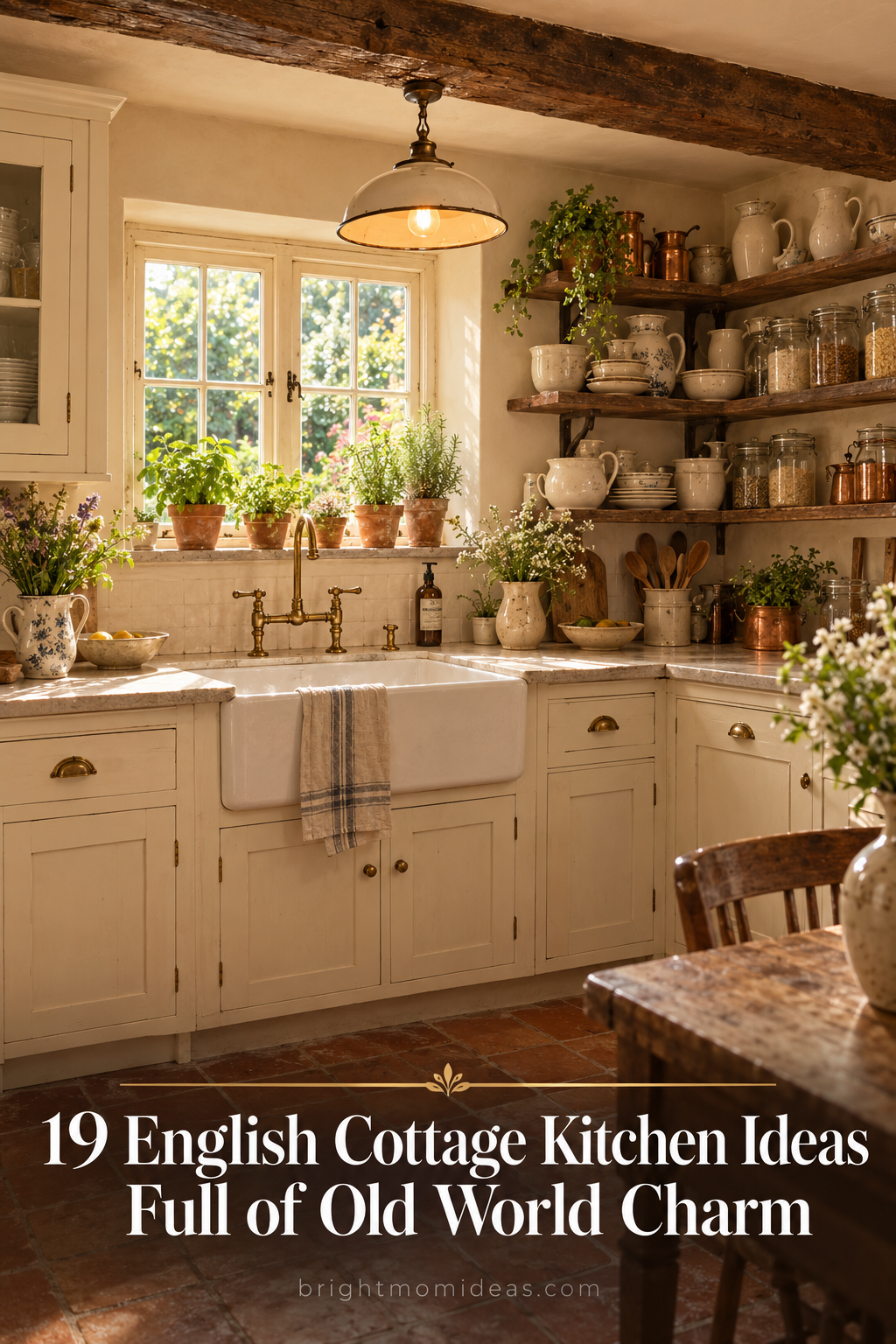
Not because it is old or worn or in need of renovation. But because every element in it has been chosen and placed with the same quiet confidence that comes from knowing exactly what you love and exactly where it belongs. The cream-painted cabinets with their slightly imperfect finish. The farmhouse sink deep enough to wash a week’s worth of dishes in one standing. The open shelves holding white ceramics and glass jars and a few things that have no practical purpose but that nobody would ever think to remove. The window above the sink with a view of something green.
Qualities of the Old World — likely antique items or vintage European décor — create a purposeful feeling from a home’s interior. This is not an architectural style, but rather a purposeful feeling given from a home’s interior. Styling in this sense allows for spaces to feel cozy and lived-in, all while maintaining an up-kept and purposeful feel.
That is the English cottage kitchen. And in 2026 it is genuinely one of the most searched, most saved, and most genuinely beloved kitchen aesthetics on Pinterest in the USA — which tells you something important about what people are actually looking for in a kitchen right now.
They are not looking for minimalism and they are not looking for industrial stainless steel or handle-less cabinets or a kitchen that looks like it belongs in a commercial space. They are looking for warmth. For personality. For a kitchen that feels like it was designed by someone who actually cooks and actually lives in it rather than someone who designed it to photograph well for a listing. The English cottage kitchen delivers all of those things and has been doing so for centuries.
This guide covers 19 ways to bring that quality into your own kitchen.
What Makes an English Cottage Kitchen Different From Every Other Style
This is worth defining clearly because the English cottage kitchen is frequently confused with farmhouse style, French country, and cottagecore — each of which shares some qualities but is fundamentally different.
The quintessential English country kitchen boasts vintage stoves, patinaed finishes, and charm in spades — pairing modern conveniences with original and period-inspired details. They are more about capturing a sensibility than any particular era.
That phrase — capturing a sensibility — is the key to understanding what makes an English cottage kitchen distinct. It is not a checklist of specific elements. It is a feeling. A quality of warmth and authenticity and the gentle accumulation of things that have been loved and used rather than purchased and arranged.
The English cottage kitchen is rooted in the English countryside tradition of the working kitchen — a room built for actual use, with real pots hanging from real hooks and real china on real shelves and a real sink deep enough to actually clean things in. The beauty in this aesthetic comes from function rather than decoration. Objects are beautiful because they work and are used and are genuinely necessary — not because they were purchased to fill a gap in the styling.
Soothing neutral tones and heirloom style infuse the kitchen with warmth and create a friendly space for guests to gather. The mix of neutral tones, warm wood floors, and stone accents elevates the cottage-inspired elements while still feeling current and inviting.
This is the quality that distinguishes an English cottage kitchen from its cousins. A French country kitchen is more formal and more color-forward. A farmhouse kitchen is more rustic and more American in its references. A cottagecore kitchen can lean whimsical. An English cottage kitchen is quietly confident — specific, considered, and deeply warm without trying to be any of those things deliberately.
The English Cottage Kitchen Color Palette

Color in an English cottage kitchen is never loud. It is never the first thing you notice. But it is doing significant work — creating the warm envelope within which every other element of the kitchen can be beautiful.
Cream and off-white are the foundation colors of the English cottage kitchen. Not stark white — that belongs to a different aesthetic entirely. The cream of an English cottage kitchen has yellow or pink undertones that make it feel warm and slightly aged. It is the color of old porcelain, of linen that has been washed many times, of the pages of a book that has been read in sunlight. Benjamin Moore Linen White, Farrow and Ball Clunch, and Sherwin-Williams Creamy are all in this family.
Sage green and dusty olive are the most popular cabinet colors in the English cottage kitchen in 2026. They reference the English countryside directly — the color of hedgerows in autumn, of kitchen garden herbs, of the slightly muted greens visible through every window in the West Country. Farrow and Ball Mizzle, Farrow and Ball Calke Green, and Benjamin Moore Yorktown Green all achieve this dusty complex green quality.
Warm stone and aged linen appear in the walls, the countertops, and the flooring. These neutral tones create continuity between surfaces and allow the more characterful elements — the open shelving, the ceramics, the hardware — to stand out without competing with each other.
Touches of deep burgundy, warm navy, or rich plum appear in accent elements — a painted cabinet in a deeper tone, a set of ceramic pieces in a warm dark glaze. Rich plum cabinetry paired with brass hardware creates a palette that feels dramatic but still soft, with a quiet storybook quality — wooden utensils, rustic boards, and fresh herbs make it feel like a place where bread is always baking and the windows are open to the garden.
19 English Cottage Kitchen Ideas
1. Cream Shaker Cabinets With Aged Brass Hardware
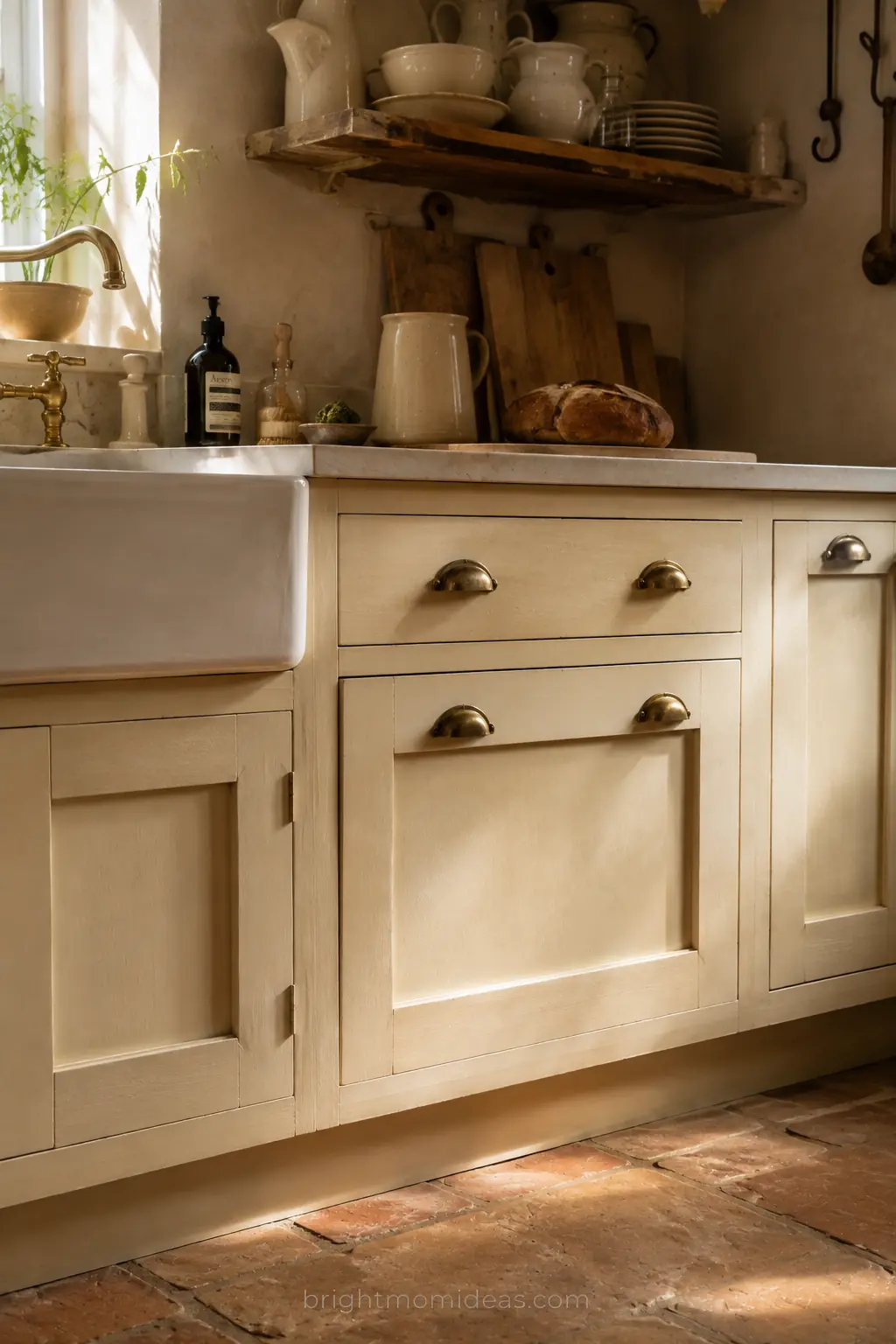
The cream shaker cabinet is the single most defining element of the English cottage kitchen. Nothing else communicates this aesthetic as immediately or as completely.
Shaker cabinets — with their simple recessed panel door fronts — originated in the American Shaker furniture tradition but have been the standard cabinetry form in English country kitchens for generations. The clean simple lines of a shaker door allow the quality of the paint finish and the hardware to do the design work rather than the cabinet detail itself.
Paint the shaker cabinets in a warm cream with yellow undertones rather than a cool bright white. The difference between warm cream and cool white in a cottage kitchen is the difference between a room that feels like it belongs to someone and a room that feels like it was just installed.
Pair with aged brass hardware — not polished brass, which reads as contemporary and slightly formal, but unlacquered or antiqued brass that shows some variation in tone and suggests that it has been touched daily for years. This hardware choice is the single most transformative small detail available in an English cottage kitchen.
2. A Deep Farmhouse Sink
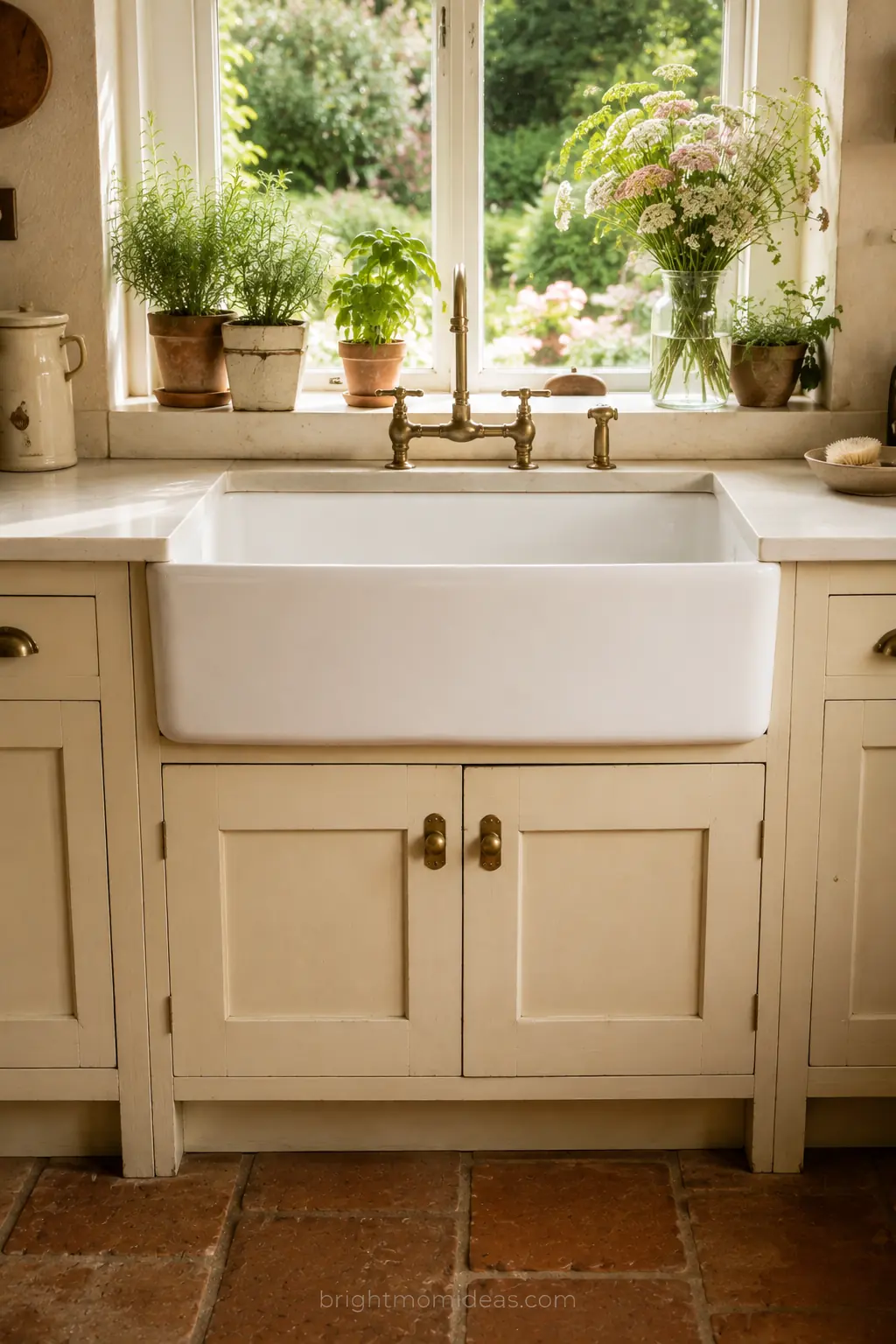
Farmhouse sinks, open shelves, and vintage charm are the perfect example of the cosy kitchen aesthetic done right.
A deep farmhouse sink — the wide apron-front basin that was the standard kitchen sink in English country homes before stainless steel and undermount became the norm — is perhaps the most functionally honest element in an English cottage kitchen. It was designed to hold a lot of water and a lot of dishes and to be used heavily. Its exposed front apron rather than cabinet-covered front communicates that function directly.
In cream or white ceramic — the traditional English farmhouse sink material — it creates a focal point at the kitchen window that is simultaneously beautiful and completely practical. The depth of the basin means that washing up at this sink feels genuinely different from a shallow contemporary sink. There is room for a full roasting pan. There is room for a large pot. And there is room to run water over flowers and vegetables and all the other things that a properly domestic kitchen involves.
Pair with a bridge faucet in aged brass or oil-rubbed bronze — the horizontal bar between two separate handles that references period plumbing fixtures and looks genuinely at home beside an apron front sink in a way that contemporary single-lever faucets do not.
3. Open Shelving Filled With White Ceramics and Glass Jars
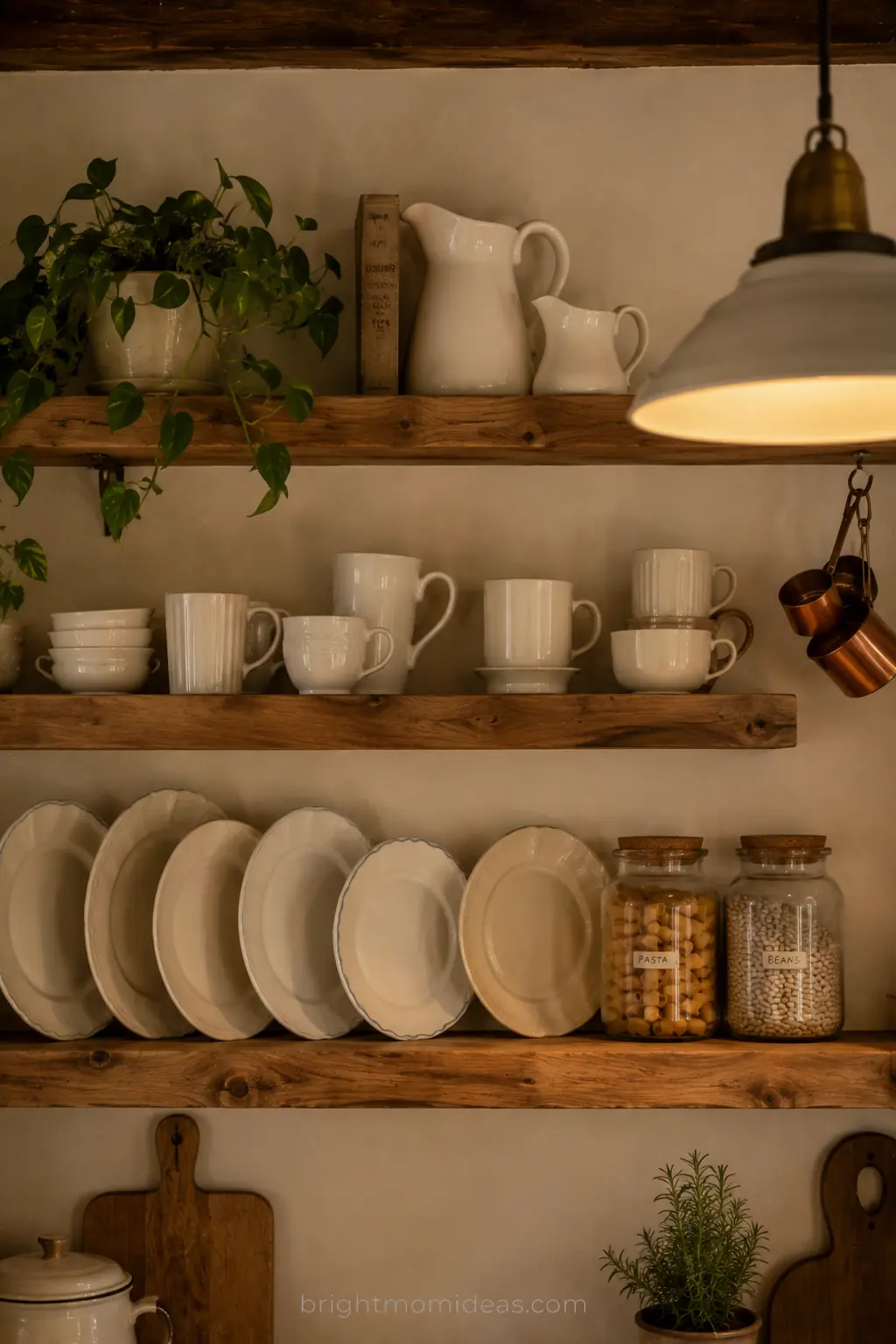
Open shelving filled with white ceramics, vintage colanders, and glass jars creates a scene that feels both practical and charming. The soft greenery trailing near the window adds just the right touch of life.
Open shelving in an English cottage kitchen is not the aspirational open shelving of a contemporary kitchen — the kind that requires everything to be Instagram-ready at all times and creates constant low-level maintenance anxiety. It is the pragmatic open shelving of a working kitchen where the things on display are there because they are used and loved and genuinely beautiful as a consequence.
White ceramics — mismatched in origin but cohesive in color — on open wooden shelves create the English cottage kitchen’s most characteristic visual moment. The slight variation between pieces — different makers, different periods, different degrees of warmth in the white — is what gives the collection its character. Everything matching uniformly reads as contemporary. Everything related but varied reads as gathered over time, which is the specific quality an English cottage kitchen should have.
Add glass storage jars for dry goods, a few copper or enamel pieces that catch the light, and a small trailing plant that spills slightly over one edge. The shelf should look curated but not styled — like someone arranged it thoughtfully once and has been adding to it ever since.
4. Exposed Wooden Ceiling Beams
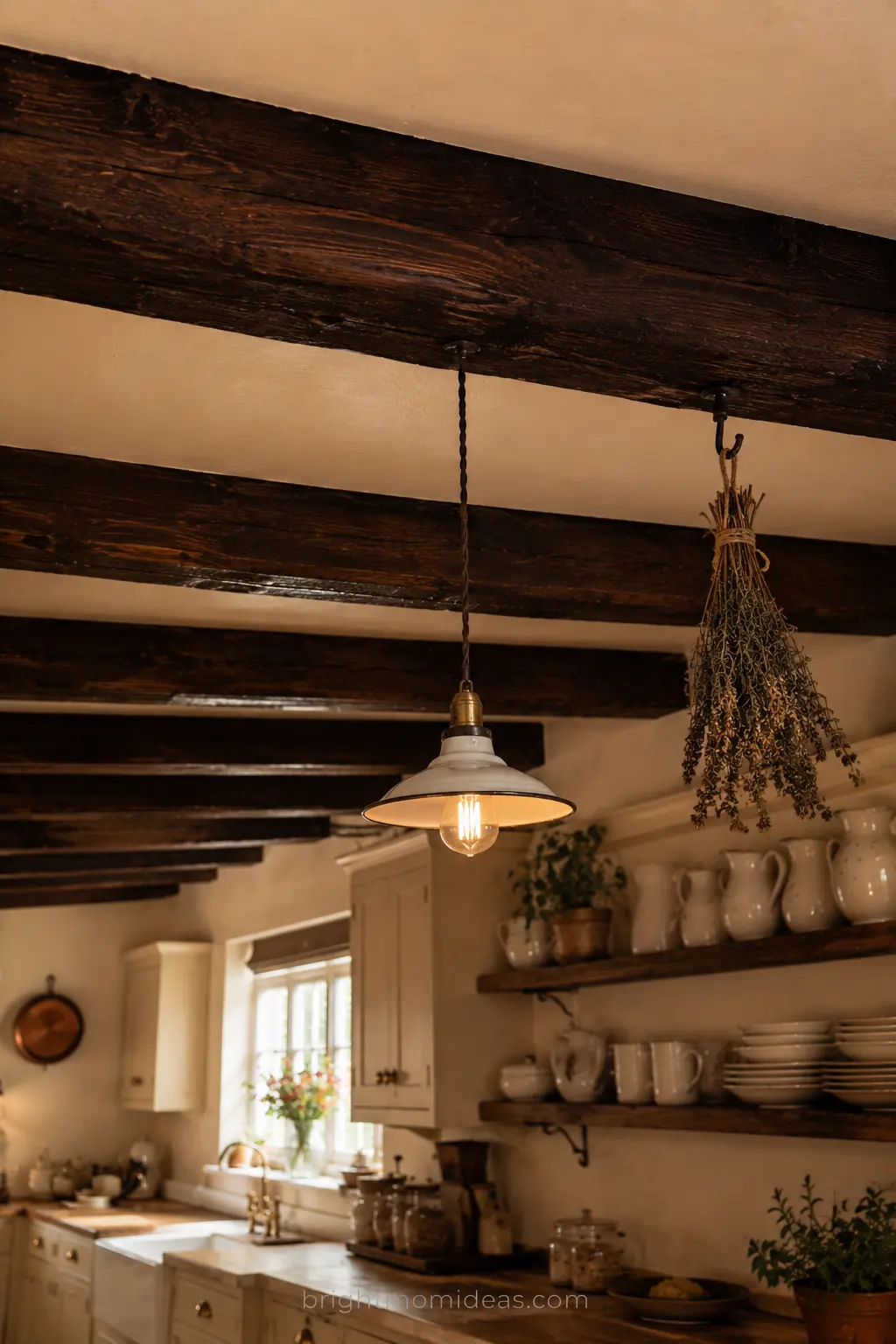
Exposed ceiling beams are one of the most architecturally distinctive elements of a genuine English cottage kitchen and one of the most sought-after details in the cottage kitchen aesthetic regardless of whether the building actually has them.
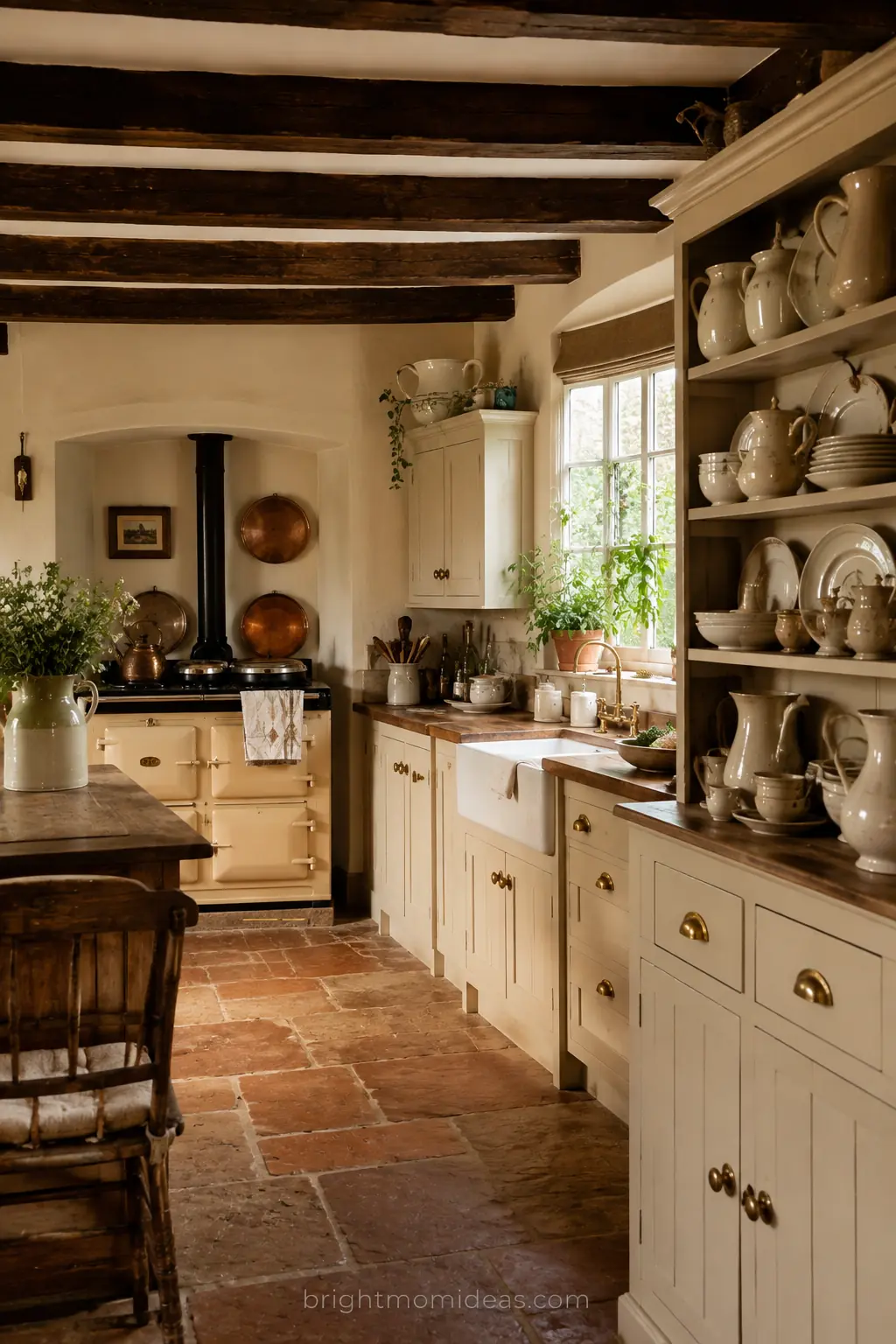
The warm wooden ceiling, open dish shelves filled with delicate china, and that charming little dining table create a space that feels lived-in and deeply loved. It is the kind of kitchen where tea gets poured in the afternoon and homemade pie cools on the counter.
Natural or dark-stained wooden beams running across a white or cream ceiling create the most characteristic ceiling of any English cottage kitchen. They reference the genuine timber-framed construction of historic English cottages and farmhouses and bring warmth and character to a ceiling that would otherwise be a missed opportunity.
In a home that does not have structural beams, decorative beam wraps — hollow wooden boxes that attach to the ceiling to create the appearance of genuine structural beams — are a legitimate and widely used approach that achieves the same visual result. Stained in a warm walnut or dark oak tone, they are difficult to distinguish from genuine structural beams and transform the ceiling of any kitchen immediately.
5. A Vintage Aga or Range Cooker
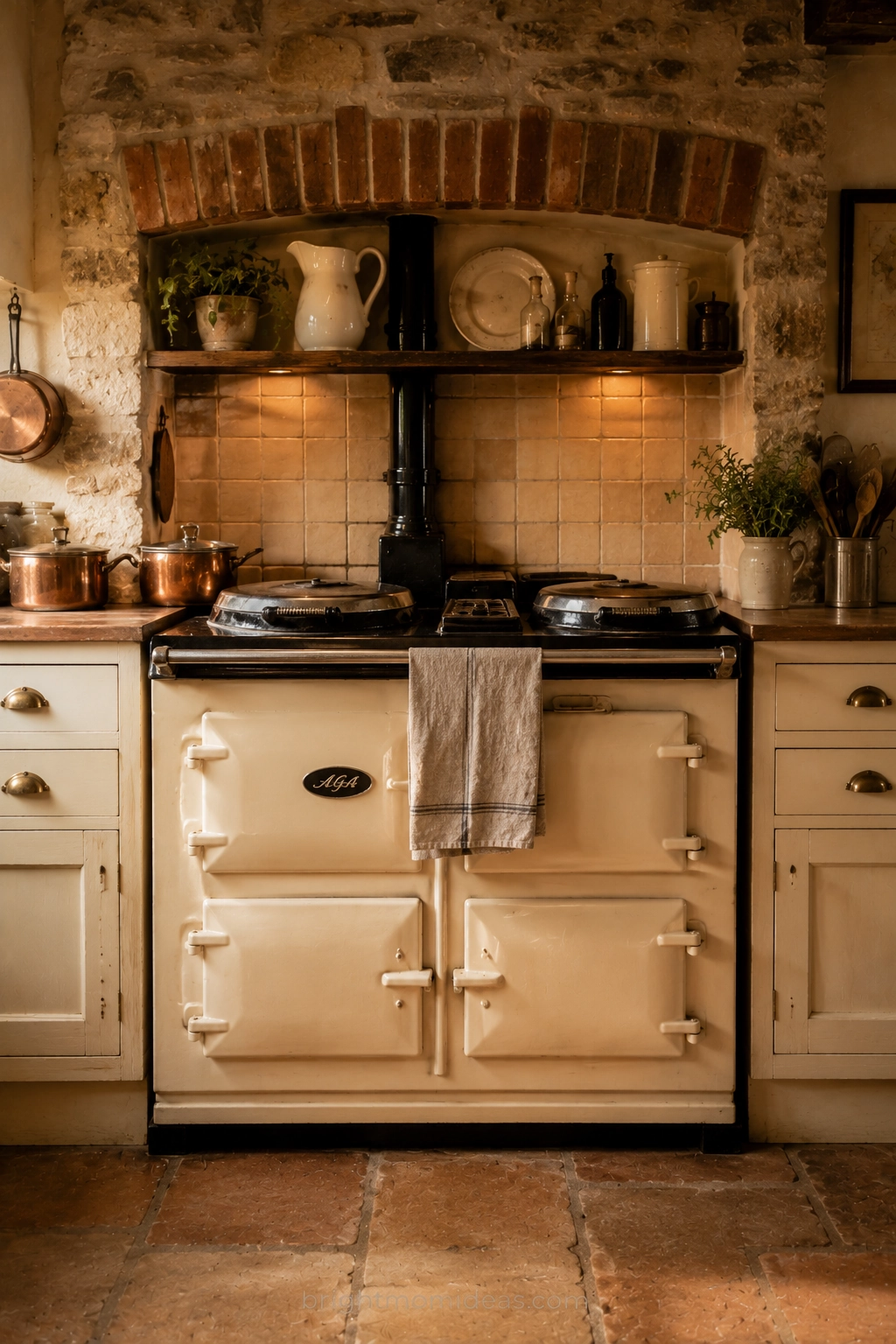
A farmhouse-style kitchen with cream AGA is a traditional English cottage style kitchen — and that built-in plate rack and shelf combo is one of the most coveted details.
The Aga is the English cottage kitchen equivalent of the farmhouse sink — an element that began as purely functional and became an aesthetic icon through decades of association with the specific kind of cooking and domestic warmth that the cottage kitchen represents.
A cream or sage green Aga range cooker — whether a genuine Aga or one of the many range cookers inspired by its form — creates an immediate and unmistakable focal point in a cottage kitchen. The cast iron body, the warm top, the slightly industrial quality of the knobs and doors, and the way it radiates gentle warmth into the kitchen even when not cooking all contribute to the specific atmosphere that no conventional range quite achieves.
For kitchens where an Aga is not possible, a range cooker in a similar form — with multiple ovens, solid cast iron grates, and a substantial presence in the kitchen — creates the same visual weight and the same domestic quality.
6. Plate Racks and Built-in Dish Storage
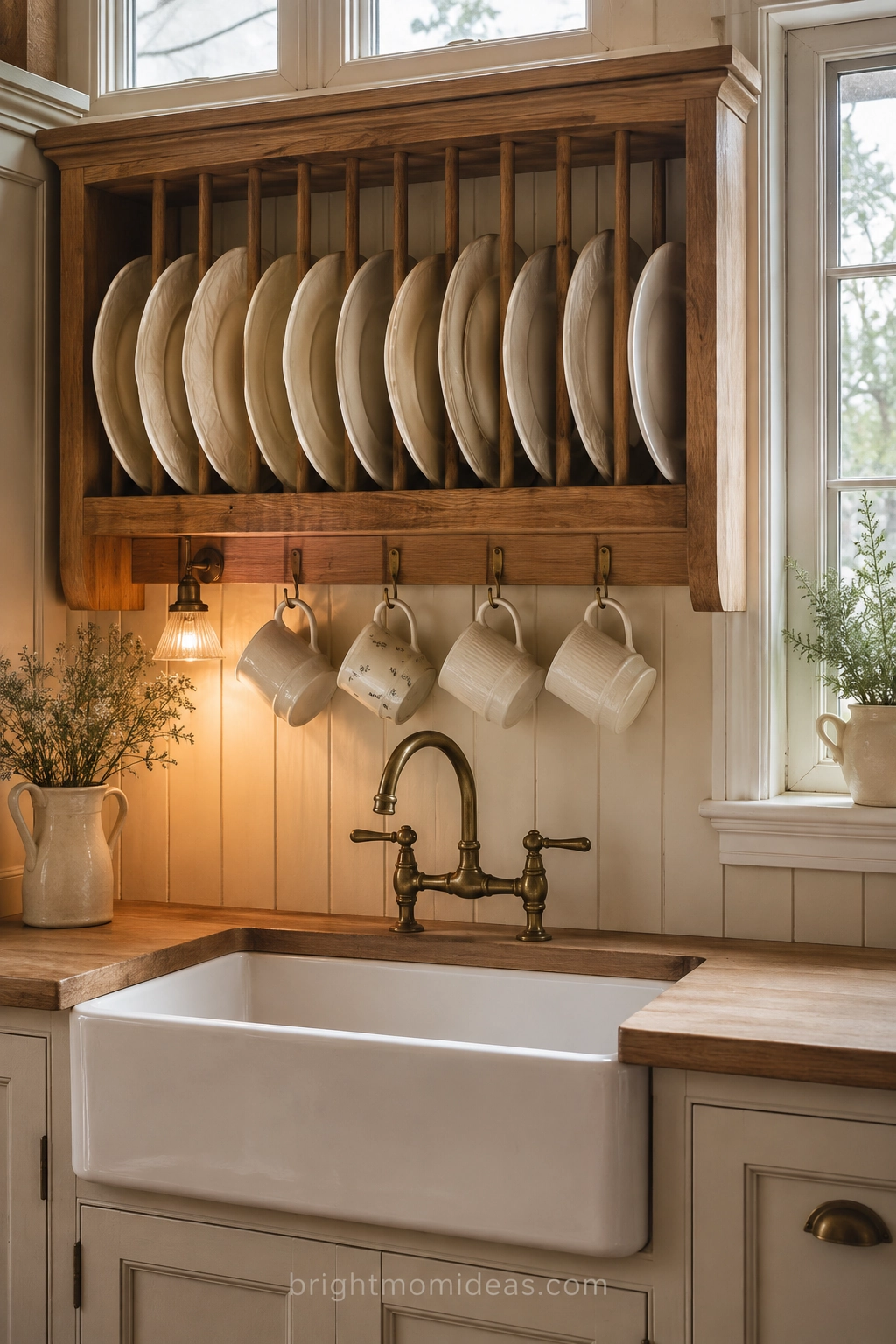
That built-in plate rack and shelf combo is one of the most coveted details in a traditional English cottage style kitchen.
The built-in plate rack — a wooden rack fitted above the sink or above a counter where plates can drain and be stored simultaneously — is one of those functional elements that became a design detail through sheer period authenticity. It references the kitchens of English country houses from the eighteenth and nineteenth centuries, where plates were washed and stored in the same dedicated wall-mounted rack.
In a 2026 cottage kitchen, a plate rack fitted into the wall cavity above the sink or between upper cabinets holds a collection of white or cream dinner plates in a way that is both beautifully functional and genuinely characterful. The plates visible in the rack become part of the room’s display — which is exactly the relationship between function and beauty that defines the English cottage kitchen at its best.
7. Butcher Block or Reclaimed Wood Countertops
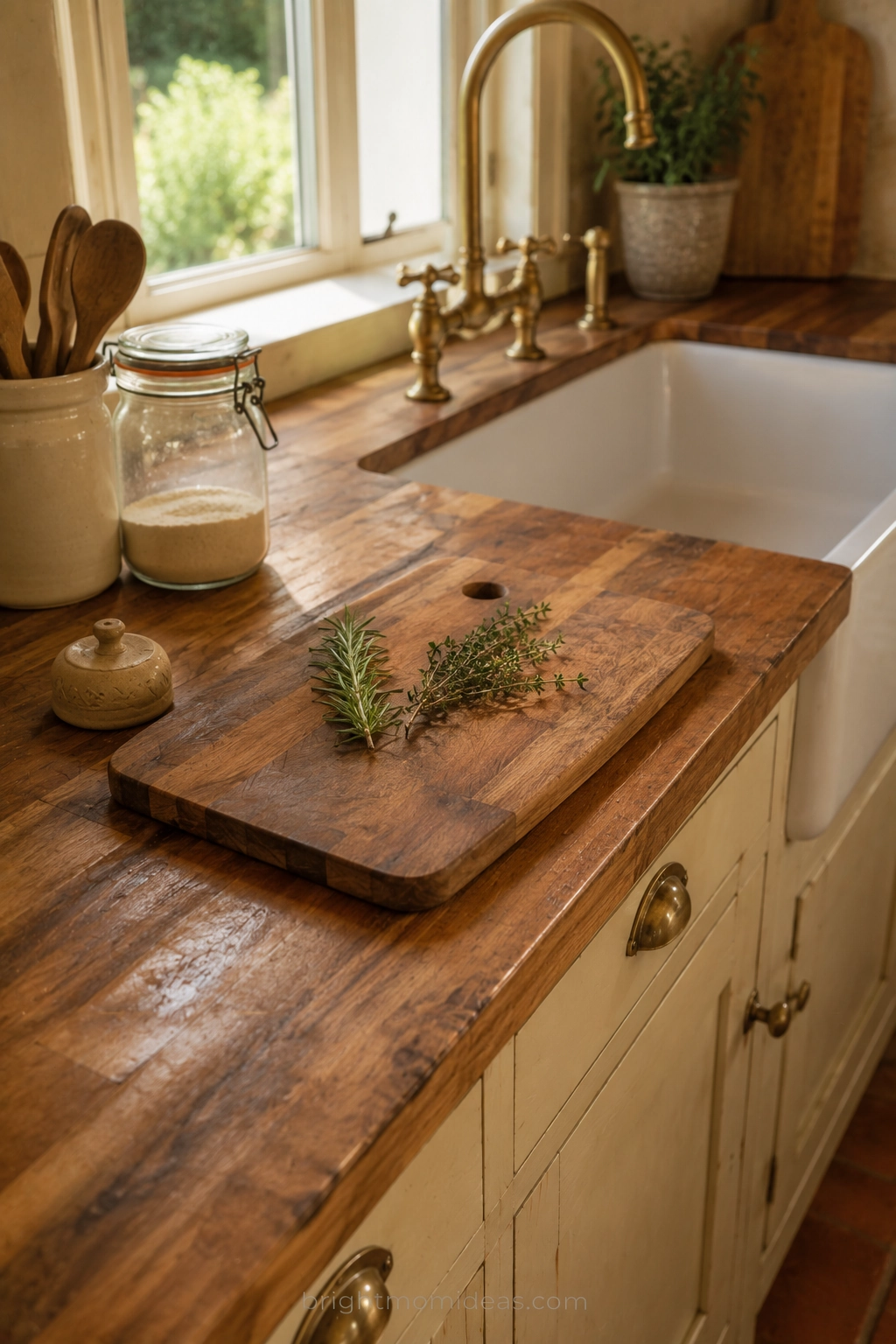
Warm wood countertops are one of the most sensory pleasures of an English cottage kitchen. The warmth of wood underhand during food preparation, the way it develops a patina from regular use, and the organic variation in the grain all contribute to a working surface that improves rather than deteriorates with time.
Handsome walnut counters will patina over time, adding to the rich, historical feel of this warm and inviting kitchen. Mixing wood textures, khaki cabinets, and rustic stonework creates a timeless space that the family can enjoy for generations.
Butcher block in a warm tone — honey oak, warm walnut, or a mixed hardwood — is the most accessible wood countertop option and the one most associated with the English cottage kitchen aesthetic. Reclaimed wood countertops — made from salvaged floorboards, barn wood, or workshop timber — add the additional dimension of genuine history. The marks and variations in reclaimed wood are not defects. They are exactly the quality that makes the countertop feel like it belongs in a room with exposed beams and a farmhouse sink.
8. Sage Green Lower Cabinets With Cream Uppers
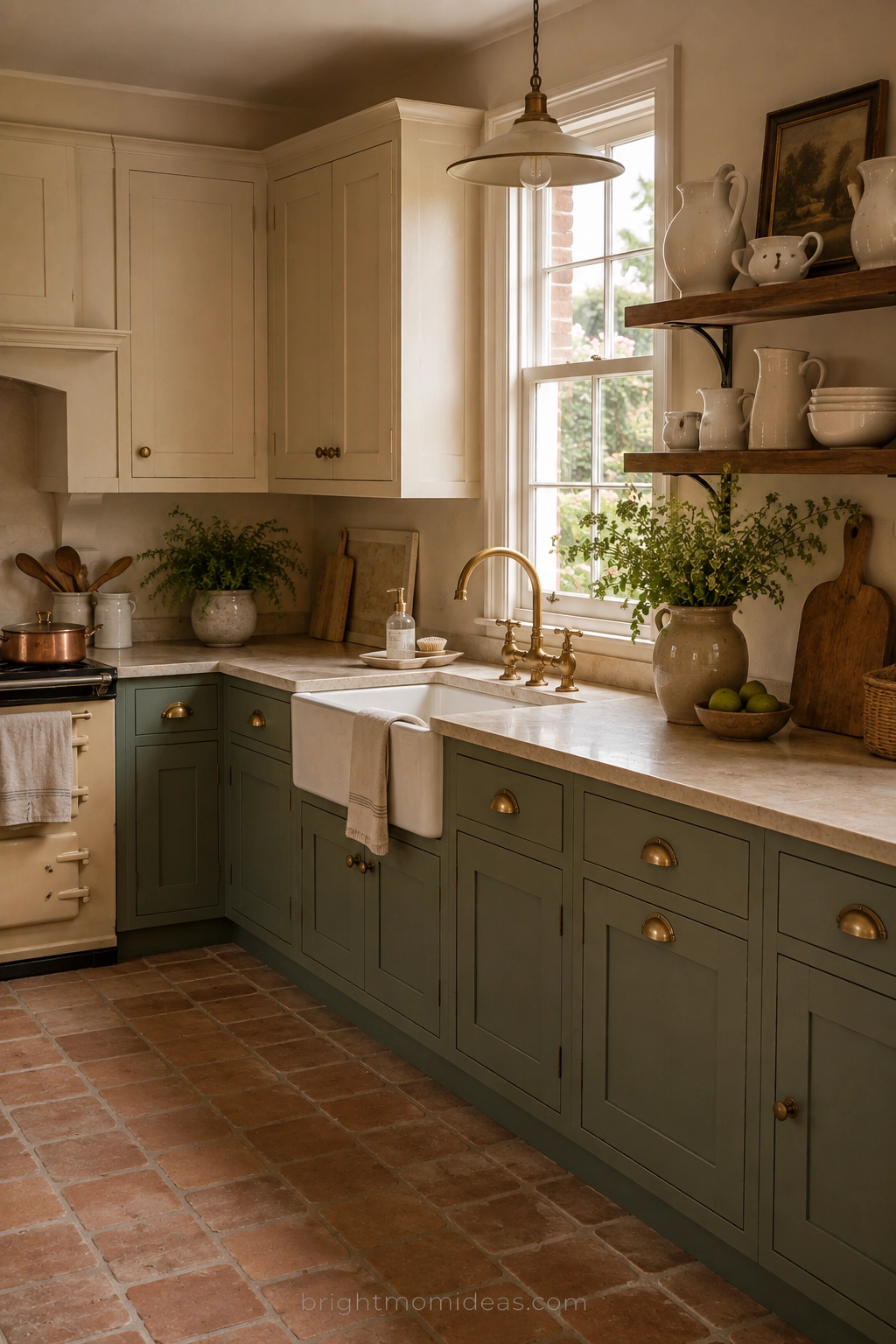
The two-tone cabinet approach — deeper more saturated color on the lower cabinets, lighter cream or white on the upper cabinets — is one of the most reliably beautiful combinations in the English cottage kitchen and one of the most searched configurations on Pinterest right now.
Sage green lower cabinets anchor the kitchen with genuine color and depth. Cream upper cabinets keep the eye level and above feeling light and airy. The countertop between them — whether in stone, wood, or a combination — bridges the two tones and creates a visual rhythm that makes the kitchen feel organized and considered without being rigidly symmetrical.
This two-tone approach also relates directly to the color palette of an English cottage garden — the greens of the planting, the cream of the stone walls, the warm neutrals of gravel paths. Bringing those proportions indoors creates a kitchen that feels connected to the countryside aesthetic even in an urban setting.
9. Terracotta or Stone Floor Tiles
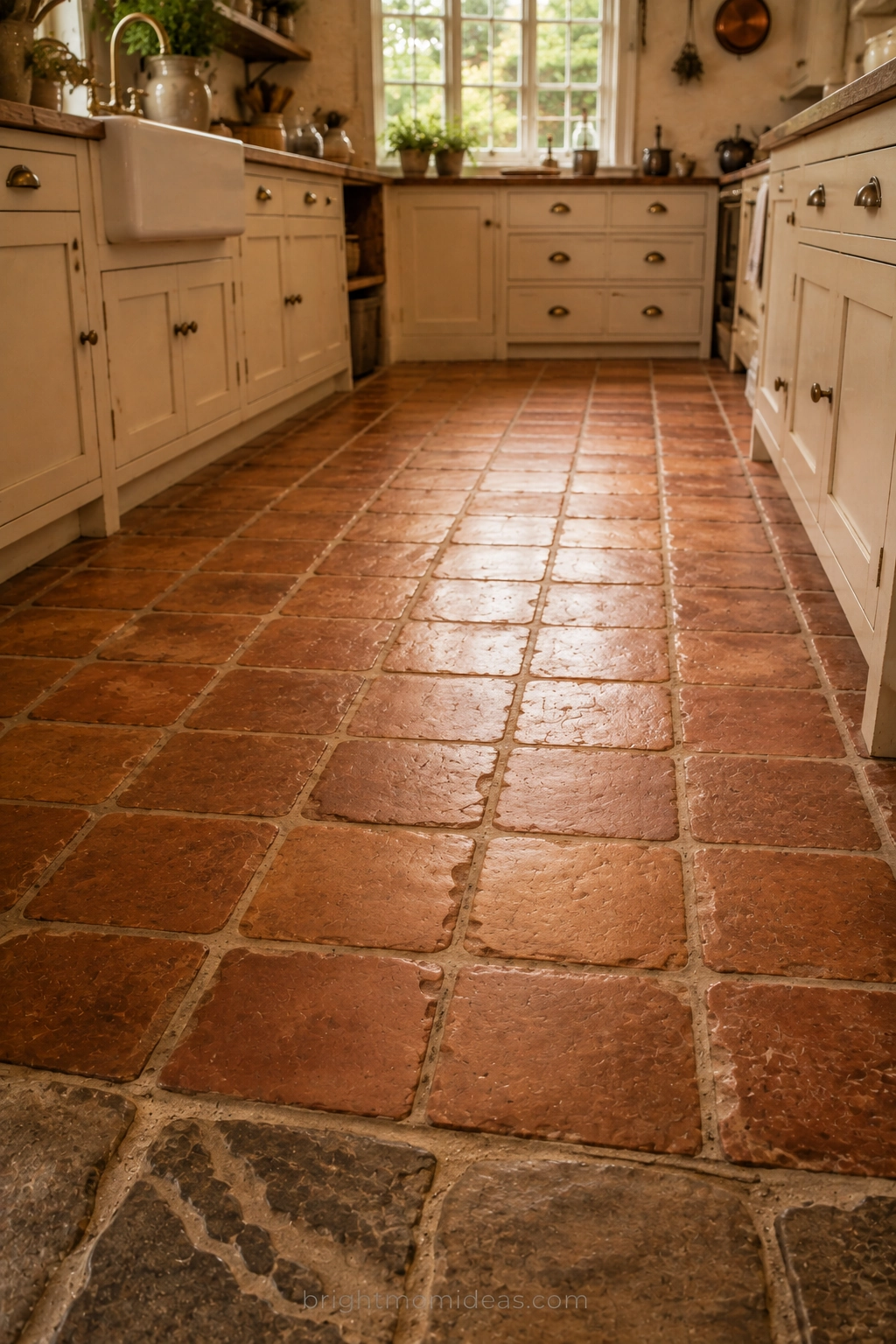
The floor in an English cottage kitchen is not a background element. It is a material statement — the choice of surface that most immediately communicates whether the kitchen belongs to the countryside aesthetic or to a more contemporary one.
Terracotta tiles — the warm orange-red clay tiles that have been used in English and European domestic kitchens for centuries — create the most authentically old-world floor available in a cottage kitchen. Their slight variation in color from tile to tile, their warm surface temperature relative to ceramic or stone, and their connection to the natural materials tradition of the English countryside all contribute to a floor that feels genuinely timeless.
Large format stone-look tiles in warm cream or pale gray achieve a similar quality with lower maintenance requirements. Flagstone — either genuine quarried stone or a convincing replica — references the stone-floored sculleries and kitchen passages of historic English houses in a way that no other floor material quite replicates.
Whichever material you choose, the grout color matters significantly. Warm sand or buff grout between terracotta tiles creates cohesion. Dark gray grout between cream stone tiles creates graphic definition. Both are appropriate to the cottage aesthetic. Cool white grout is not.
10. Vintage or Antique Lighting Fixtures
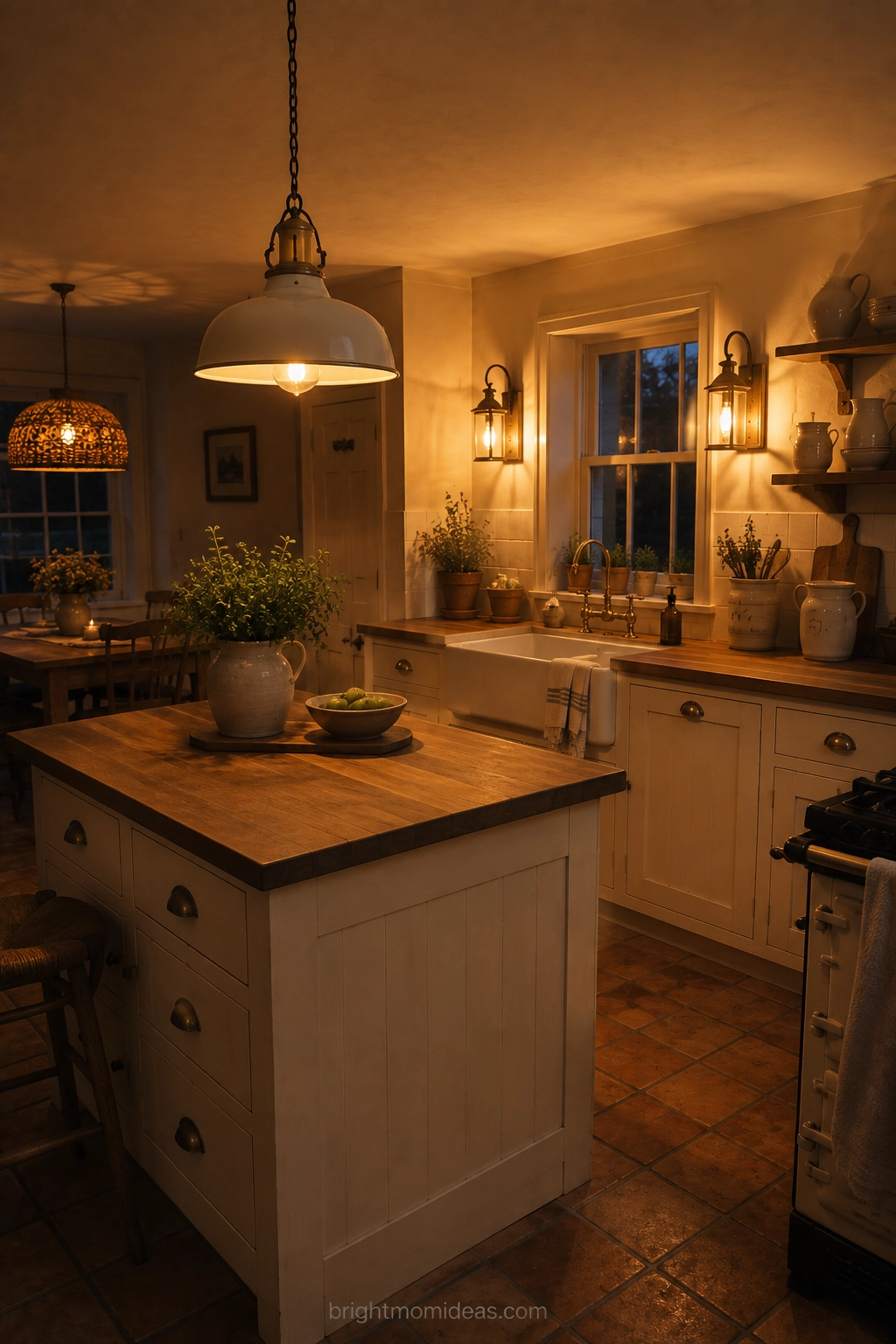
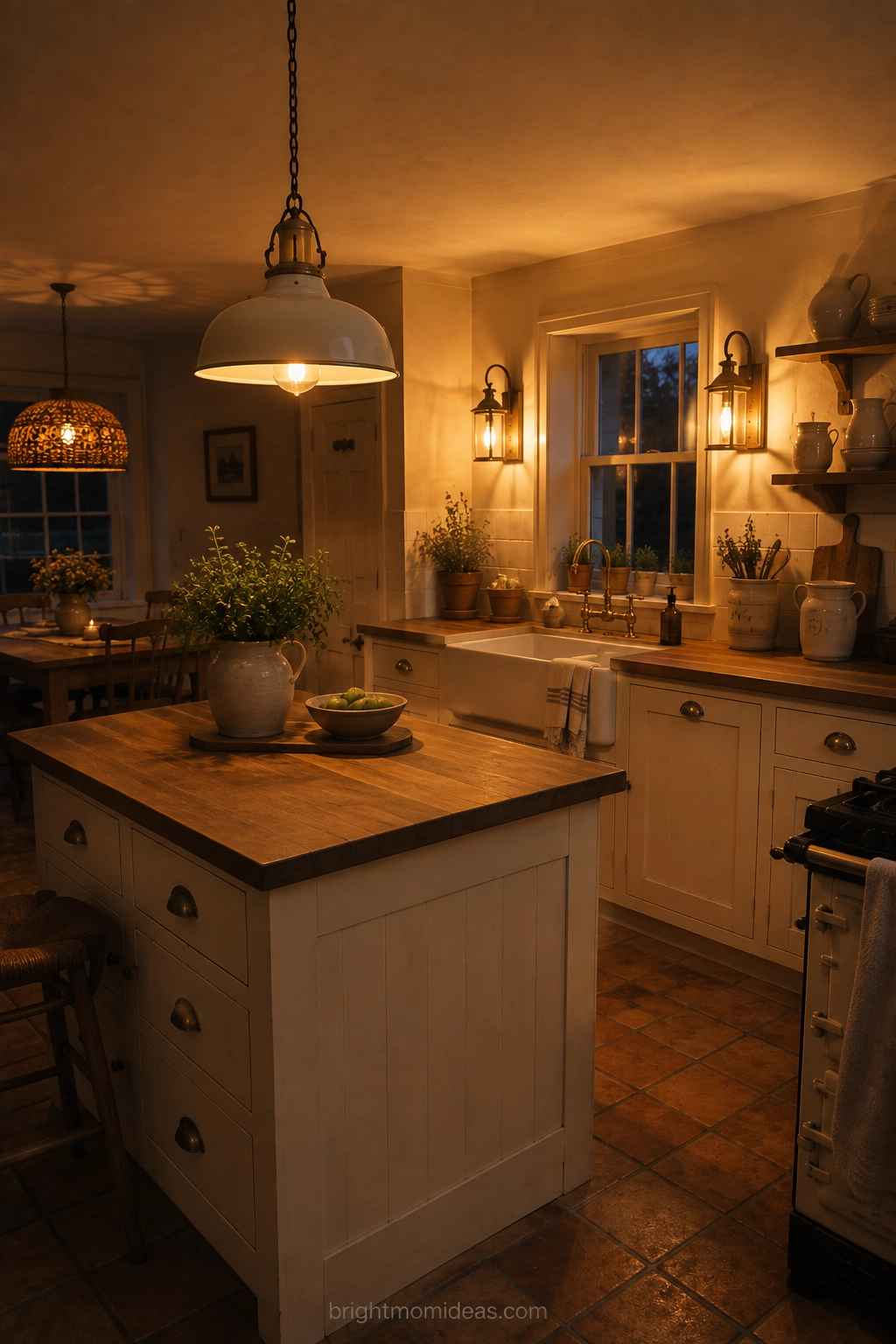
A wicker pendant light and brass fixtures add rustic elegance, making a cottage kitchen truly unique and inviting.
Lighting in an English cottage kitchen should look like it was there before the kitchen was designed around it — not like it was chosen to match everything else. The vintage or antique quality of the fixture, whether genuine antique or period-inspired reproduction, is what creates this sense of the kitchen having accumulated its character over time rather than being assembled all at once.
Enamel pendant lights — in cream, sage, or dark olive — hung above a kitchen island or work surface reference the industrial-domestic lighting of English farm buildings and workshops. Brass lantern-style pendants with glass panels and visible bulbs add the warm-toned metallic quality that relates to aged brass hardware throughout. A large rattan or wicker shade above the dining table within the kitchen creates warmth and organic texture.
All fixtures in a cottage kitchen should use warm 2700K bulbs. Cool lighting in a cottage kitchen is the fastest way to undermine the warmth and authenticity that every other design decision in the room is working toward.
11. An Herb Garden on the Windowsill
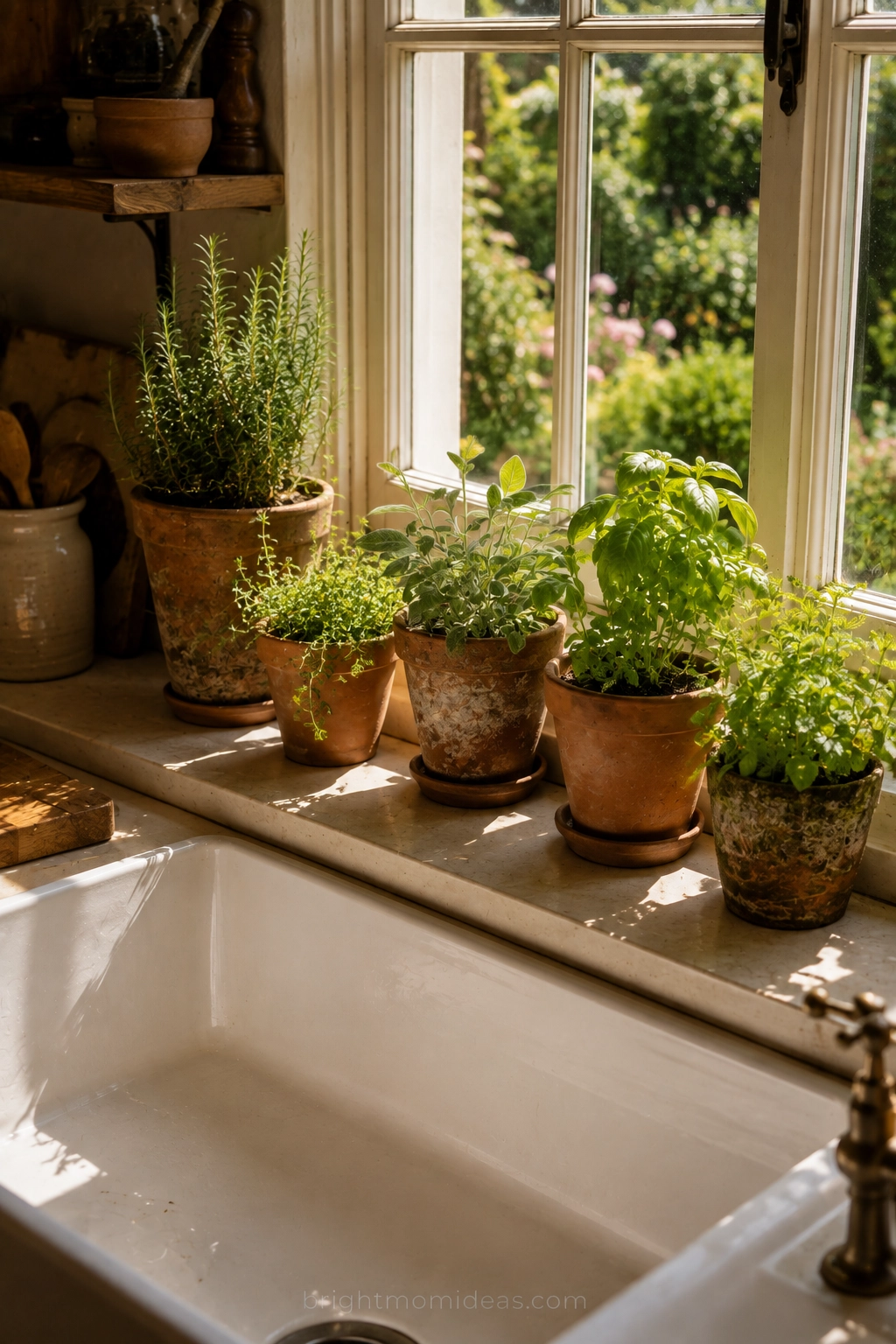
Fresh herbs make the cottage kitchen feel like a place where bread is always baking and the windows are open to the garden.
The herb garden on the windowsill is not a decorating detail. It is a statement of intent about what kind of kitchen this is and what kind of cooking happens in it. It says that fresh herbs are used here regularly — that someone stands at this sink and reaches to the right for rosemary to add to roasting potatoes and to the left for basil to tear onto a tomato salad.
Small terracotta pots of herbs — rosemary, thyme, sage, mint, basil — arranged on the windowsill above the sink create both the fresh green element that every English cottage kitchen needs and the working kitchen quality that makes the room feel genuinely inhabited. The pots should be mismatched in size and slightly well-used in appearance. Matching pristine pots create a designed quality that works against the authentic feeling of the cottage kitchen.
12. A Vintage Welsh Dresser or Kitchen Dresser
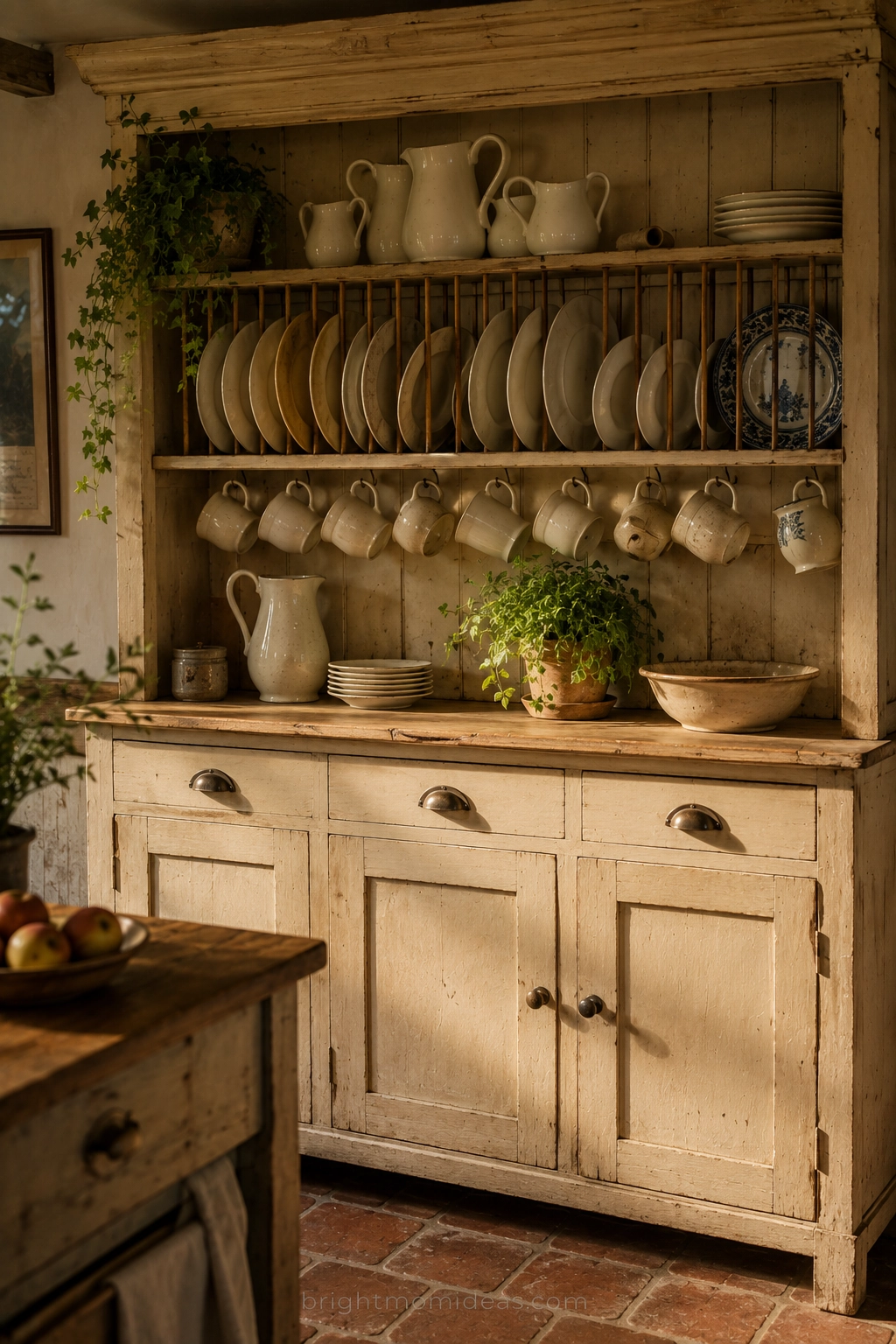
The kitchen dresser — a large freestanding piece of furniture with open shelves above and cupboard storage below — is one of the most characterful and most functional pieces of furniture available to an English cottage kitchen.
A genuine antique Welsh dresser or a period-inspired reproduction creates a display and storage moment that built-in cabinetry cannot replicate. The dresser has legs. It has a specific position in the room that it has occupied by design rather than by fitting. It holds plates and cups and pitchers and serving pieces in a way that makes them look like a collection rather than storage.
The display on a cottage kitchen dresser should look unselfconsciously beautiful — white and cream ceramics of different origins and periods arranged together with serving pieces and a few decorative objects that belong to the room without being purely decorative. The dresser is the most personal piece of furniture in an English cottage kitchen and should look like it.
13. Brick Backsplash
A timeless brick backsplash in the kitchen contrasts understated walnut countertops and a smart navy refrigerator to create an elevated space with built-in functionality.
A brick backsplash — either genuine exposed brick or a thin brick tile — is one of the most characterful wall treatments available in an English cottage kitchen. The texture of brick, its warm orange-red tone, and its genuine reference to the construction materials of English country buildings all contribute to a backsplash with real depth and history.
In a cream-painted kitchen, a brick backsplash adds the one element that breaks the painted uniformity in the most natural and most authentic way. The bricks become a visible record of the building itself — a reminder that the kitchen sits within walls that have substance and history rather than walls that were simply erected to contain the fitted kitchen within.
14. Copper Pots and Pans on Display
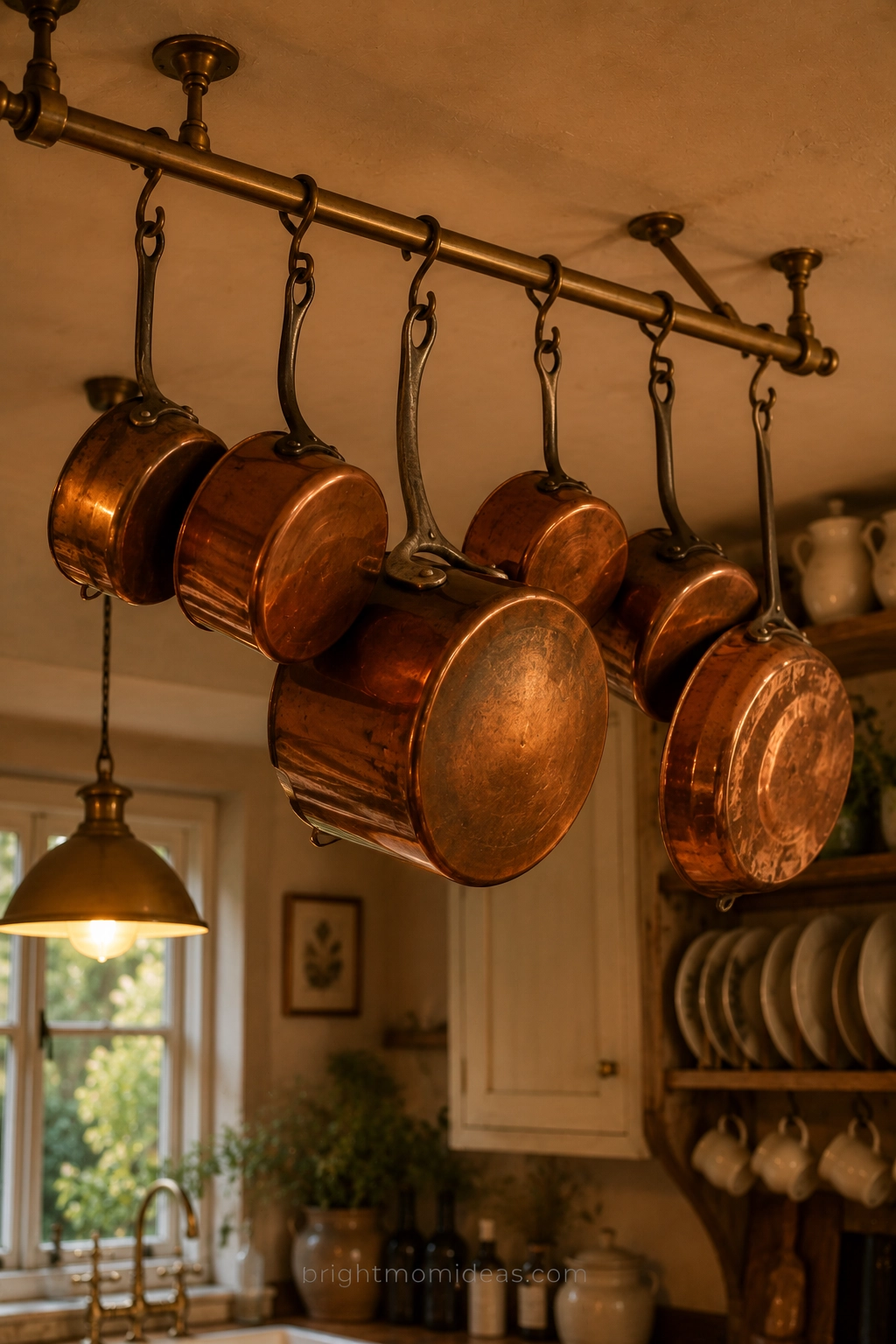
Copper cookware hanging from a ceiling rack or wall-mounted pot rail is one of the most visually dramatic and most authentically cottage displays available in any kitchen. The warm golden-orange tone of copper against cream walls creates a color contrast that is immediately warm and genuinely beautiful. The functional quality of the display — these pots are hung here because they are used regularly and need to be accessible — gives it the honest pragmatism that is central to the English cottage kitchen aesthetic.
A pot rail mounted to the ceiling above an island or against the wall near the range, hung with a collection of copper pots and pans in different sizes, creates a display that improves over time as the copper develops its natural patina. New copper is bright and slightly brash. Aged copper is mellow and warm and exactly right for a cottage kitchen.
15. Floral Wallpaper Accent
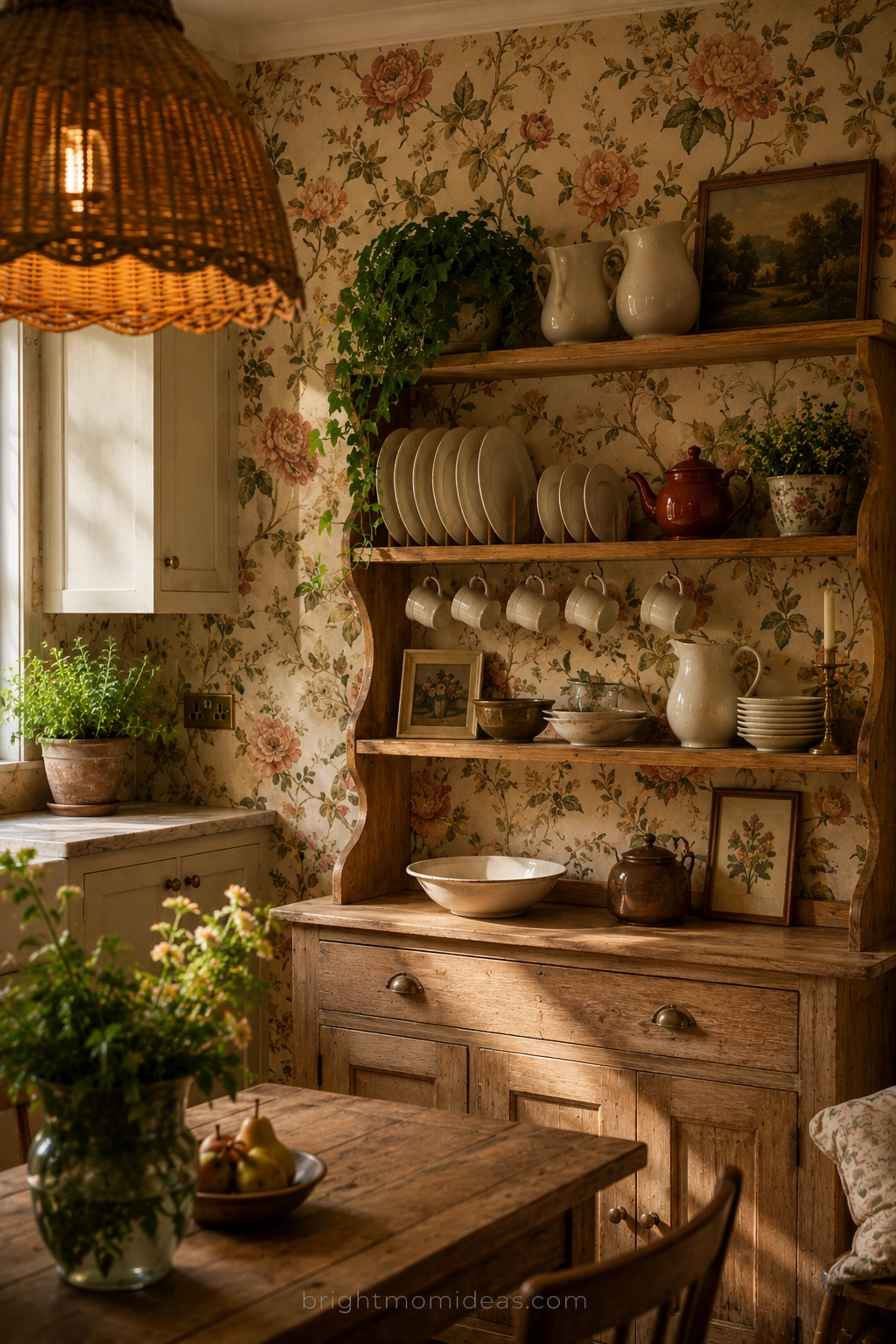
A vibrant floral rose wallpaper with warm wooden countertop showcasing a vintage red teapot collection and ceramic cups creates a cozy display. A stylish wicker pendant light and brass fixtures add rustic elegance, making this a truly unique and inviting kitchen design — perfect for home.
Floral wallpaper in a kitchen sounds like a bold decision. In an English cottage kitchen it sounds like the most natural one in the world. English cottage interiors have used floral wallpaper for generations — it is as native to this aesthetic as the farmhouse sink or the Aga.
The specific floral pattern matters. The most cottage-appropriate prints are the ones that feel as though they were inspired by an actual garden rather than designed from scratch — soft repeated botanical patterns in cream and sage, larger-scale traditional floral prints in warm rose and green, or delicate sprigged patterns that would not look out of place in a country house from any period in the past two hundred years.
Apply the wallpaper to one wall — typically the wall behind a shelving unit or dresser — rather than all four walls in a small kitchen. The restraint of one wallpapered wall allows the pattern to be a genuine feature rather than an overwhelming presence.
16. A Slate or Stone Sink
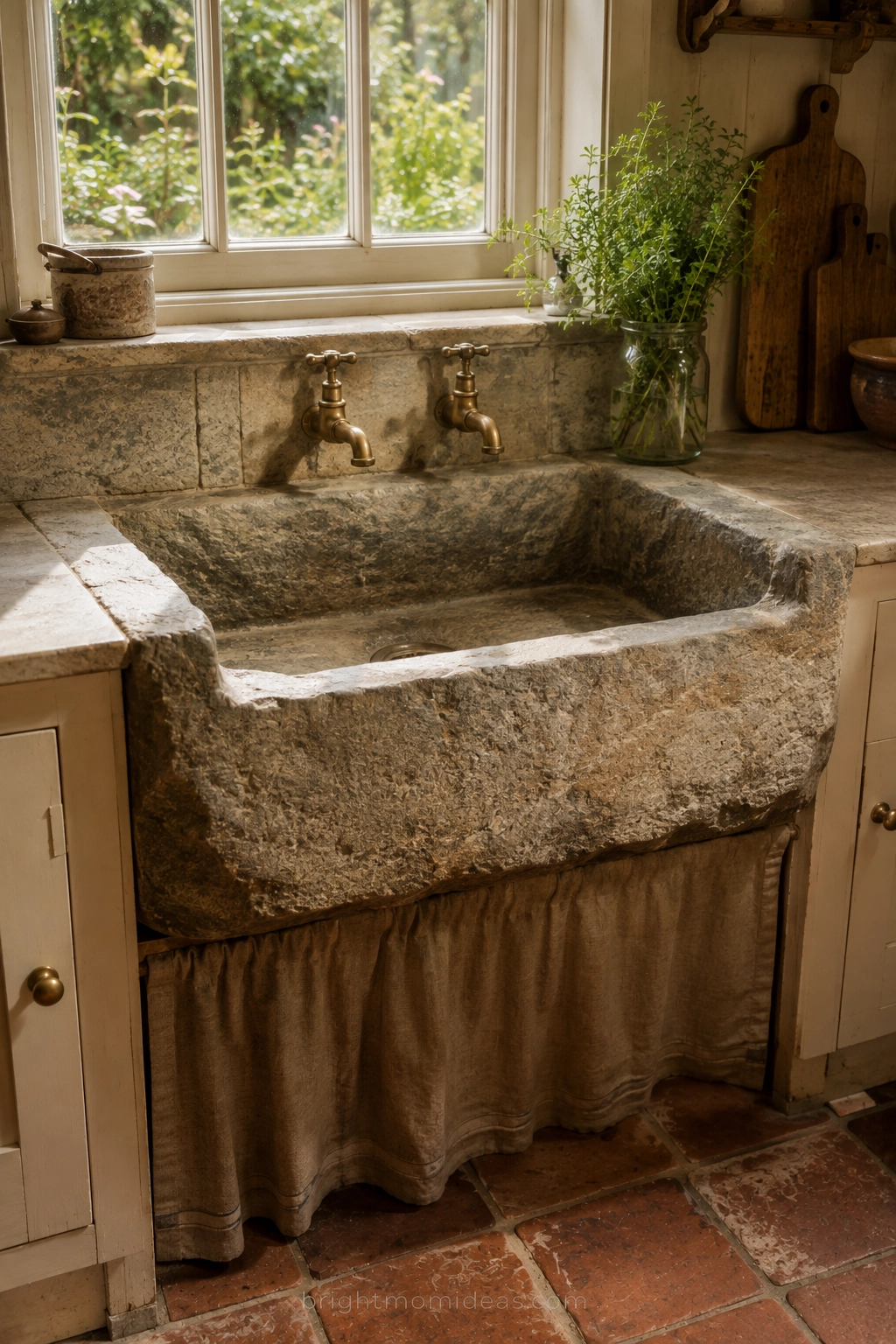
A slate or stone sink — whether a genuine reclaimed stone trough or a period-inspired reproduction in a similar material — creates the most ancient and most genuinely old-world effect of any sink available in a cottage kitchen. Stone sinks reference the original kitchen sinks of English country houses from before the era of ceramic and stainless steel — the solid practical stone basins that were chiseled from the same stone as the floors and walls.
In a 2026 kitchen a stone sink sits alongside all modern plumbing and functions exactly as any other sink. But its visual presence — the weight and substance of the stone, the depth of the basin, the color and texture of the material — creates a focal point that no ceramic or steel alternative can match for sheer period authenticity.
17. Mismatched Vintage Chairs Around a Farmhouse Table
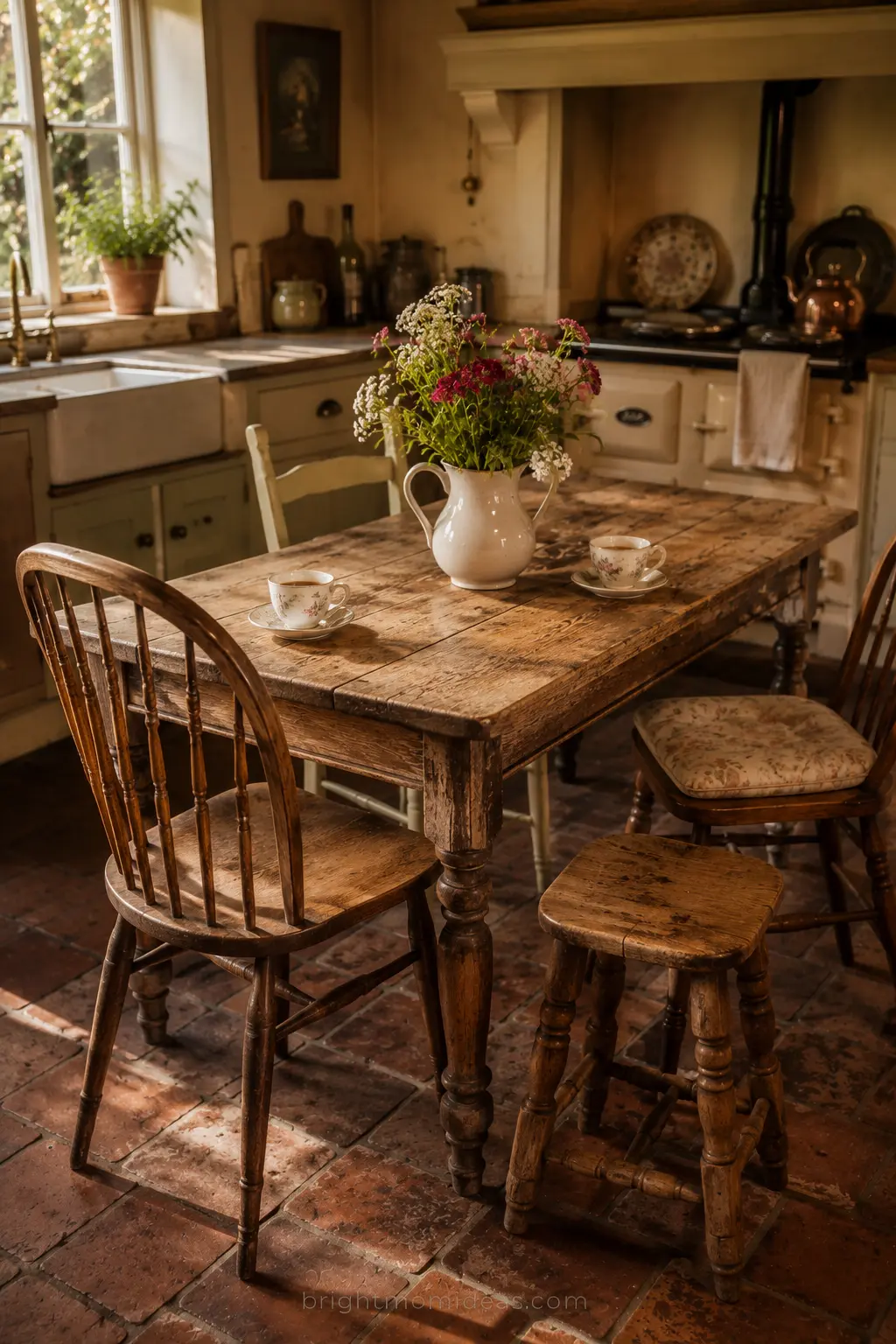
That charming little dining table creates a space that feels lived-in and deeply loved — it is the kind of kitchen where tea gets poured in the afternoon.
An eating area within the kitchen — a farmhouse table with a collection of chairs that do not match in origin but that feel cohesive in tone — is one of the most inviting elements of an English cottage kitchen. The table is there for daily use rather than formal dining. It is where the morning coffee is drunk and where the afternoon tea is poured and where homework gets done while dinner is being prepared.
Mismatched vintage chairs around a kitchen table communicate something important about the room — that it has been collecting furniture over time from sources that were convenient and wonderful rather than matched and purchased. A Windsor chair beside a ladder-back beside a simple painted wooden chair beside a small upholstered side chair — this collection looks like a cottage kitchen and feels like one.
18. Vintage Tins, Crockery, and Collectibles on Display
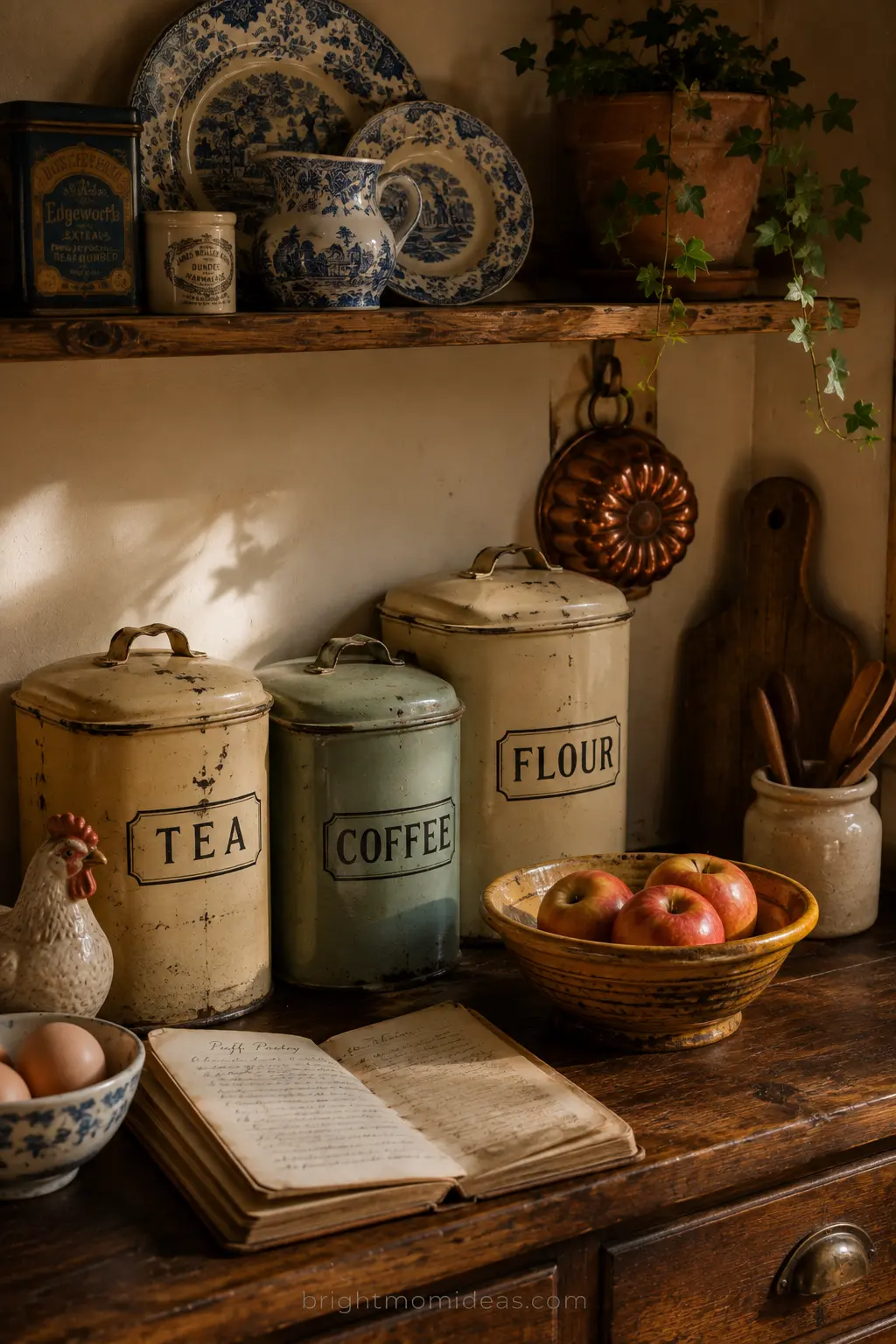
The small decorative details of an English cottage kitchen are what make it feel personally inhabited rather than aesthetically designed. Vintage storage tins in printed enamel or battered tin. Old recipe books with cloth spines arranged on a shelf. A collection of blue and white transfer-ware plates. A ceramic chicken on the counter beside the eggs. A hand-thrown pottery bowl in a warm glaze next to the fruit.
None of these objects are there because a stylist placed them. They are there because someone who loves them lives in this kitchen and has been finding and keeping them for years. That quality — the sense of genuine personal accumulation — is what separates an English cottage kitchen from a cottage-inspired kitchen. One is a collection. The other is a reference.
The easiest way to develop this quality is to stop buying things and start rescuing them. Charity shops, estate sales, farmers markets, and antique fairs are the right sources for the objects that belong in a cottage kitchen. They will not match. They will not be pristine. And they will be exactly right.
19. A Kitchen Garden View
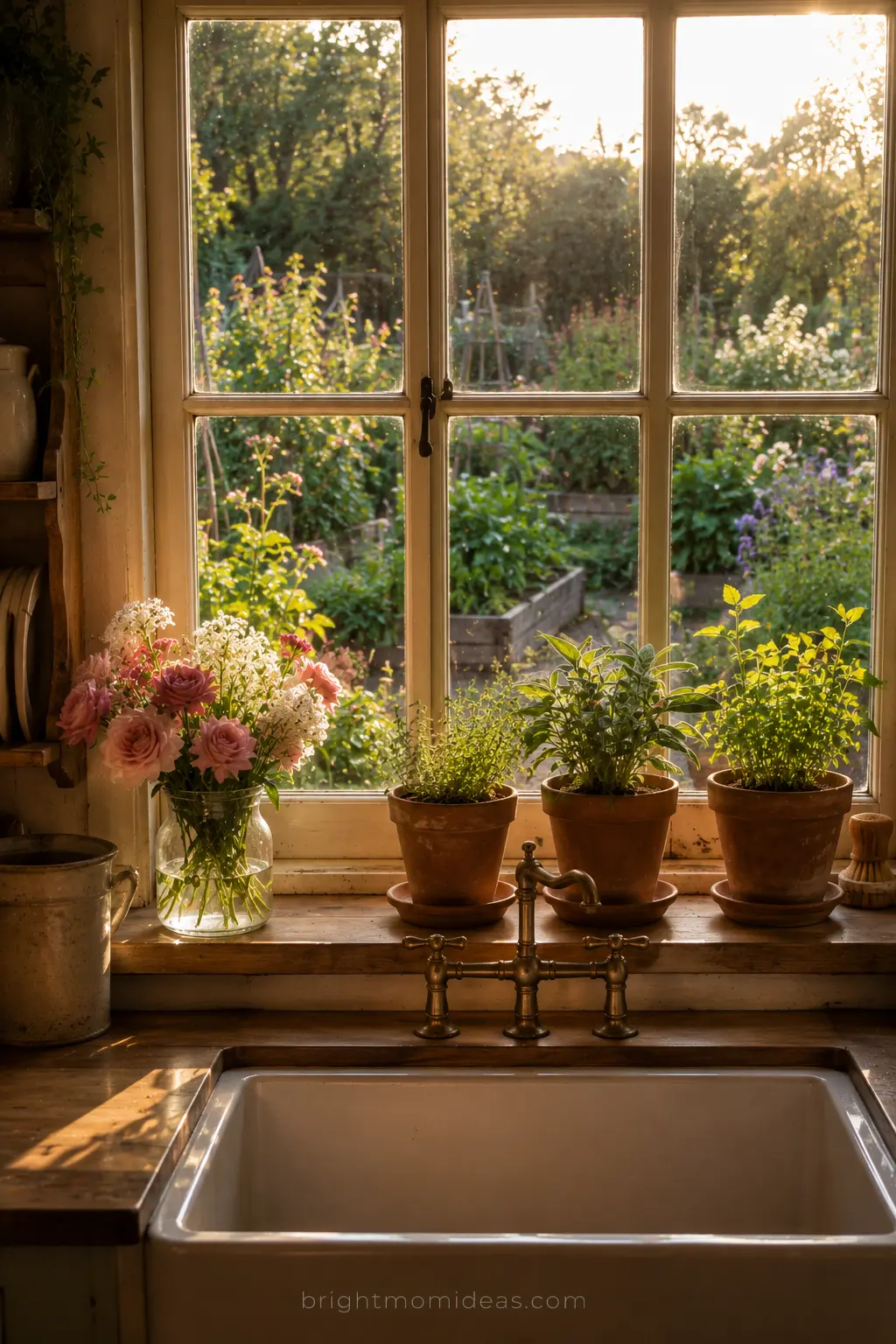
The English cottage kitchen is incomplete without a connection to the outdoors — specifically to a kitchen garden or a cottage garden that provides both the view from the sink and the actual ingredients that the kitchen processes.
This idea is the one that most directly addresses the spirit rather than the aesthetics of the cottage kitchen. An English cottage kitchen is not a room designed for looking at. It is a room designed for cooking in — and English cottage cooking is rooted in the garden in a way that no other culinary tradition quite replicates. Herbs grown outside the kitchen door. Vegetables from the kitchen garden. Flowers cut from the cottage garden and arranged in a jug on the windowsill because they are beautiful and they are there and why would you not.
Even a kitchen with no garden can create a version of this connection. A window box outside the kitchen window with herbs and seasonal flowers. A small indoor kitchen garden of terracotta pots on the windowsill. A single trailing plant above the sink that softens the boundary between the interior and whatever is outside. The connection to living green things is the quality that prevents the cottage kitchen from feeling like a museum exhibit of itself — and it is available in every kitchen regardless of its size or its setting.
English Cottage Kitchen Materials Guide
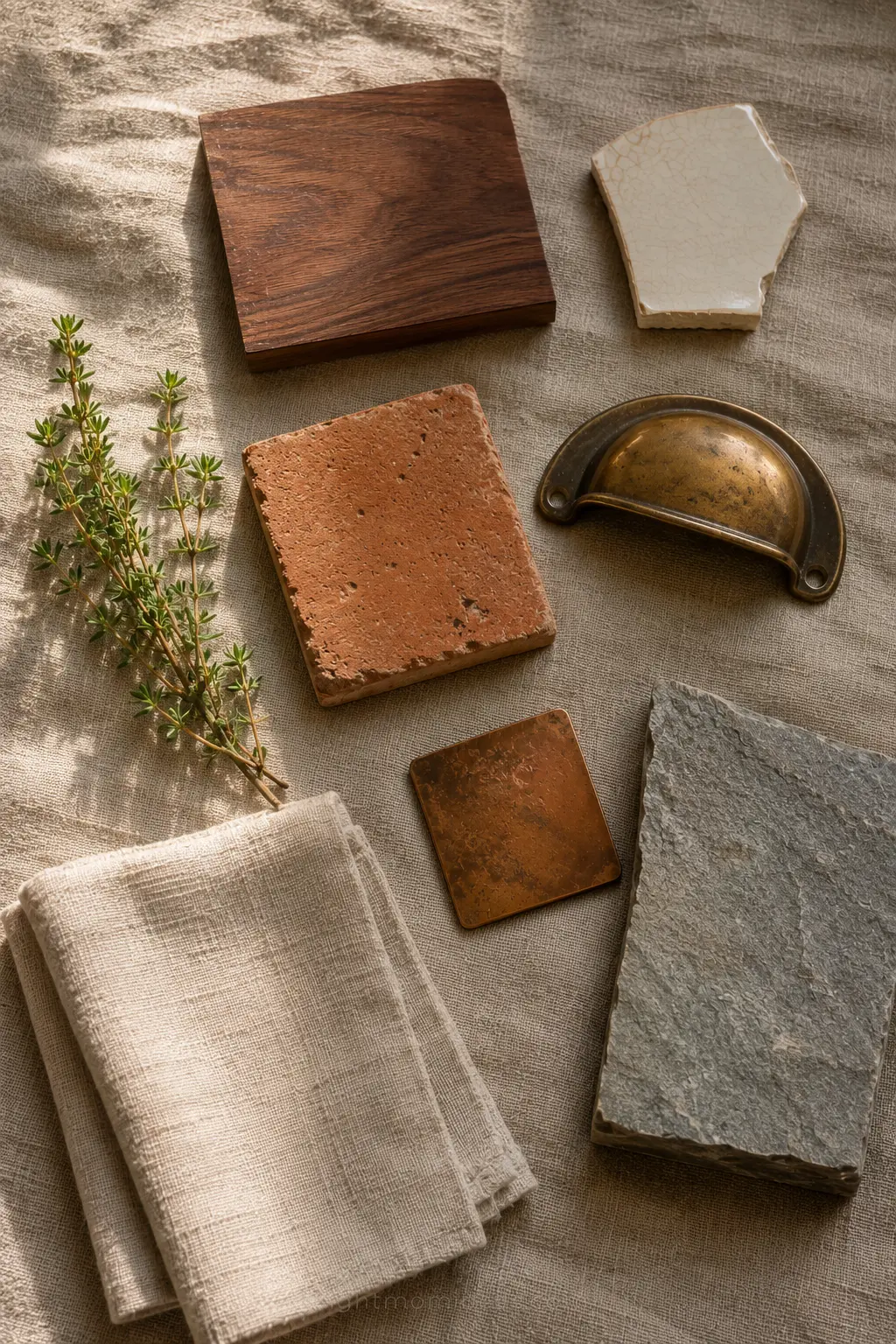
Understanding the materials that define an English cottage kitchen helps you make decisions that feel authentically cottage rather than merely cottage-inspired.
Wood is the central material of the English cottage kitchen. It appears in the cabinet fronts, the floor, the countertops, the ceiling beams, the shelving, and the furniture. The specific character of the wood — warm, slightly aged, with visible grain — is what makes these uses feel cottage rather than contemporary. Wood that is too perfect or too uniform in its finish does not achieve the same quality.
Ceramic and pottery appear throughout the English cottage kitchen in forms that are used as much as they are displayed. White and cream ceramics, transfer-ware, hand-thrown pottery in warm earthy glazes, enamelware, and vintage stoneware all belong in this kitchen.
Stone and slate appear in the floor, the sink, and sometimes the countertop. Their cold-to-touch quality and their connection to the English landscape make them among the most authentically cottage materials available.
Brass and copper appear in the hardware, the plumbing fixtures, the cookware, and the lighting. Both metals develop a patina with age and use that makes them more beautiful over time — which is exactly the quality that the cottage kitchen values above all others.
Linen and cotton appear in the textiles — dish towels hanging from the Aga rail, a linen curtain on the kitchen window, a simple tablecloth on the kitchen table. Natural fibers in warm neutral tones add the textile warmth that makes a kitchen feel genuinely domestic.
How to Achieve the English Cottage Kitchen Look on a Budget
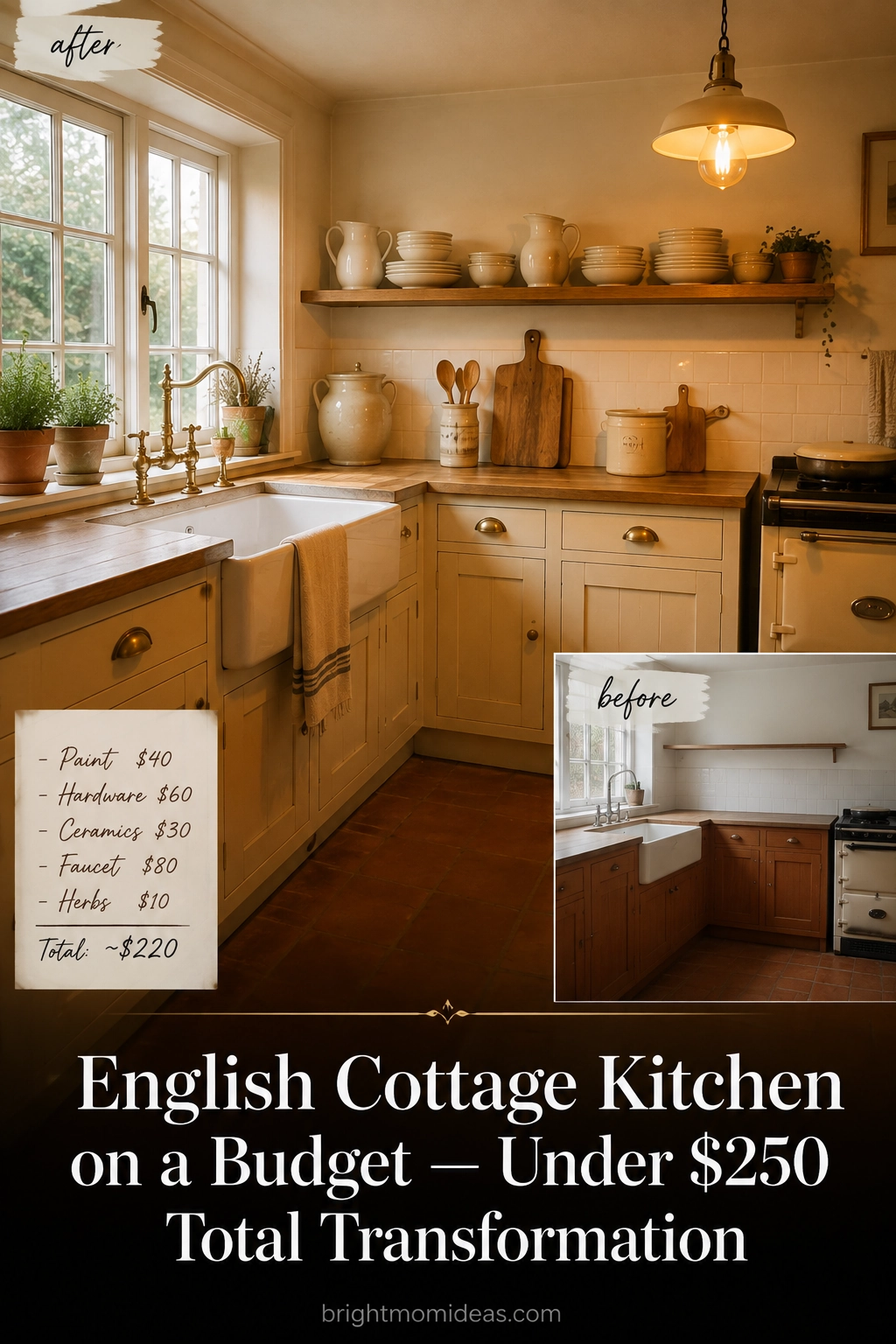
The English cottage kitchen aesthetic is genuinely more accessible than most people assume — because its most defining qualities are things that money cannot simply buy.
The character, the warmth, the sense of accumulated personal history that makes an English cottage kitchen feel the way it does — these qualities come from choices and patience and sources that are not expensive. Here is where to start.
Paint what you have. Cream chalk paint on existing cabinet fronts costs a fraction of new cabinetry and creates the same soft imperfect finish that defines the cottage kitchen. Replace the hardware with aged brass pulls. The transformation is immediate and significant.
Shop charity shops and estate sales for ceramics. A collection of white and cream ceramics from different sources and periods — assembled over several months of charity shop visits — creates a more authentic and more characterful display than anything purchased new from a matching set. The budget is minimal. The result is irreplaceable.
Add open shelving. One or two floating shelves in natural wood above a work surface or above the sink creates the open shelving display moment of an English cottage kitchen for the cost of the shelf and the brackets.
Replace the faucet. A bridge-style faucet in aged brass or oil-rubbed bronze is the single hardware change that most transforms a kitchen toward the cottage aesthetic. It is less expensive than most major design decisions and its impact is immediate.
Add plants. Terracotta pots of herbs on the windowsill. A trailing plant above the sink. A bunch of seasonal flowers in a jug on the counter. None of this costs significant money. All of it adds the living quality that is central to the cottage kitchen.
Common English Cottage Kitchen Mistakes to Avoid
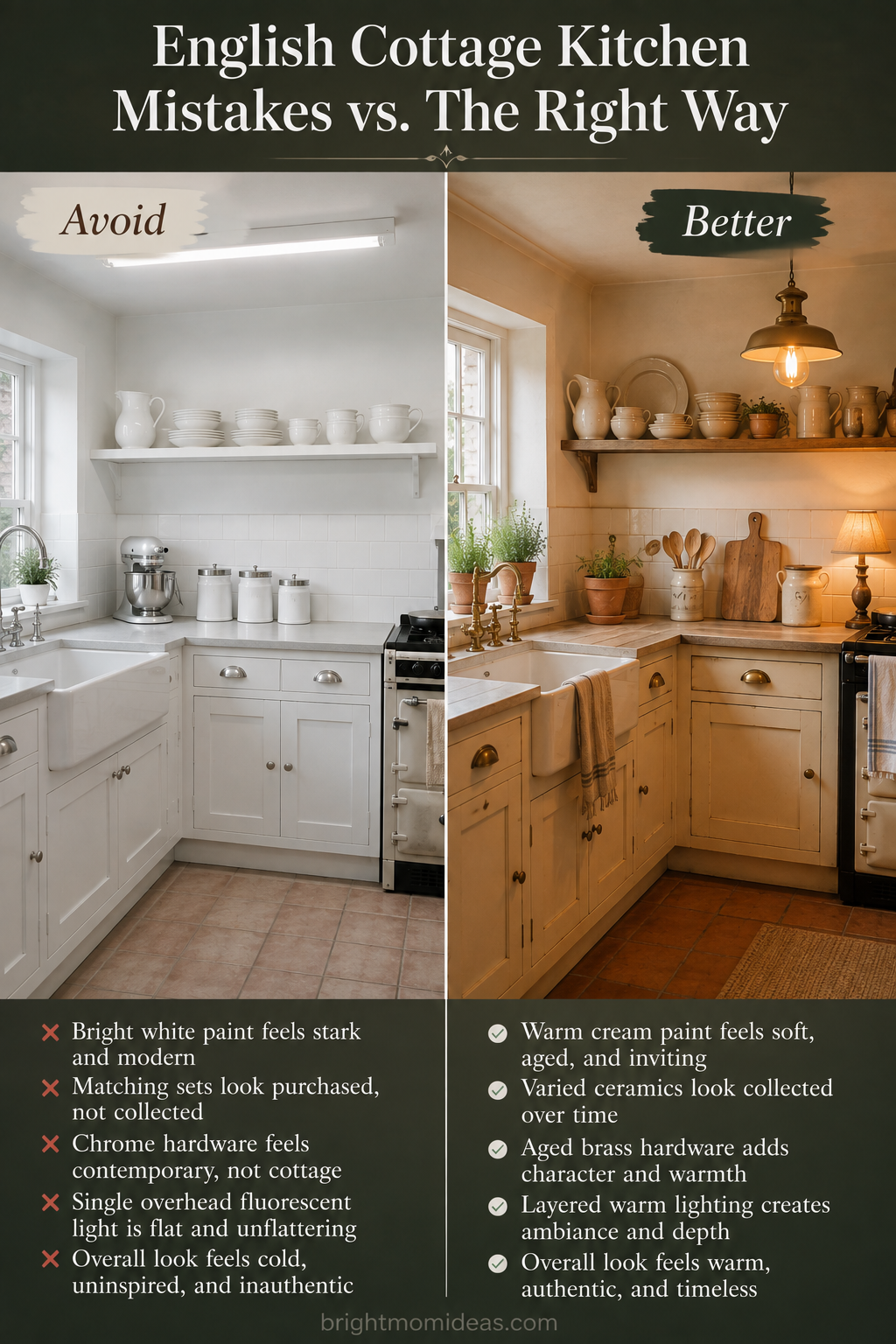
Using too-perfect or too-uniform materials creates a cottage-themed kitchen rather than a genuine cottage kitchen. The imperfection and variation in natural materials — wood grain, ceramic glaze, stone surface — is what creates authenticity. Materials that are too uniform or too pristine work against this quality regardless of their style.
Buying all-matching ceramics and accessories defeats the purpose of the open display that is central to the cottage kitchen aesthetic. The beauty of the display comes from the variation between pieces that share a color family but have different origins and histories.
Using cool white paint instead of warm cream. This is the most common and most consequential color mistake in a cottage kitchen. Warm cream is the correct white. Cool white belongs to a different aesthetic entirely.
Over-matching the hardware. In an English cottage kitchen, the hardware should feel like it was selected thoughtfully but not uniformly. A few variations in aged brass pulls, different forms on different cabinets, occasional ceramic knobs among the metal hardware — this variation reads as collected rather than designed.
Ignoring the textiles. Dish towels, window treatments, table linens, and floor mats are among the most affordable and most impactful contributors to the cottage kitchen atmosphere. Linen and cotton in warm neutral and soft pattern tones belong in this kitchen. Synthetic fabrics in bright colors do not.
FAQ Section
What is an English cottage kitchen?
An English cottage kitchen is a kitchen aesthetic rooted in the working kitchens of English country houses and rural cottages — characterized by cream or sage green shaker cabinets, deep farmhouse sinks, open shelving with white ceramics, exposed wooden beams, stone or terracotta floors, aged brass hardware, and the general quality of a room that has been cooking for a very long time. It prioritizes warmth, authenticity, and the beauty of functional objects over contemporary minimalism or decorative excess. The English cottage kitchen is more about capturing a sensibility — that of the lived-in, loved, genuinely working kitchen — than replicating any specific architectural period or style.
What colors are used in an English cottage kitchen?
The color palette of an English cottage kitchen is built on warm cream and off-white as the base tone — specifically warm creams with yellow or pink undertones rather than cool bright whites. Sage green and dusty olive are the most popular cabinet colors in 2026, referencing the muted complex greens of the English countryside. Warm stone, aged linen, and soft terracotta appear in floors and walls. Touches of deeper tones — burgundy, warm navy, deep plum — appear in accent elements. Farrow and Ball Clunch, Calke Green, and Mizzle are among the most authentically cottage paint colors available.
What is the difference between an English cottage kitchen and a farmhouse kitchen?
The English cottage kitchen and the American farmhouse kitchen share several elements — the farmhouse sink, the open shelving, the shaker cabinetry, the emphasis on warmth and lived-in quality. But they differ in their references and their overall feeling. An English cottage kitchen is rooted specifically in the domestic tradition of English country houses and rural cottages — with period-specific elements like the Aga range, the Welsh dresser, the plate rack, and the connection to the kitchen garden. An American farmhouse kitchen draws on the rural American tradition and tends toward more rustic, more explicitly country, and more barn-influenced aesthetics. Both are warm and characterful. The English cottage kitchen tends to be slightly more refined and more historically specific in its references.
How do I make a modern kitchen look like an English cottage kitchen?
The most impactful changes to bring an English cottage kitchen quality to a modern kitchen are painting existing cabinet fronts in warm cream or sage green with chalk paint, replacing hardware with aged brass pulls, adding open wooden shelving above the countertop, replacing the faucet with a bridge-style fixture in aged brass or oil-rubbed bronze, placing white ceramics and glass storage jars on the open shelves, adding terracotta pots of herbs to the windowsill, and replacing light bulbs with warm 2700K versions. These changes can be made without structural renovation and collectively create a significant shift toward the cottage kitchen aesthetic.
What floor is best for an English cottage kitchen?
Terracotta tiles, natural stone flagstone, stone-look porcelain in warm tones, and wide plank warm wood floors all work beautifully in an English cottage kitchen. Terracotta is the most historically authentic choice — these warm orange-red clay tiles have been used in English and European cottage kitchens for centuries and develop a beautiful patina with regular use. Stone flagstone is the most architectural and most expensive choice. Stone-look porcelain in warm tones provides a low-maintenance alternative that achieves a similar visual quality. All of these options should be finished with warm buff or sand grout rather than cool white grout to maintain the warmth of the overall palette.
Is an English cottage kitchen expensive to create?
An English cottage kitchen can be created across a very wide range of budgets. The qualities that define it most strongly — warmth, character, the beauty of functional objects displayed honestly — come from choices and sourcing rather than from high budgets. Painting existing cabinets, adding open shelving, replacing hardware, and collecting ceramics from charity shops and estate sales over time can create a genuinely beautiful cottage kitchen for a fraction of the cost of a designed renovation. At the higher end, custom shaker cabinetry in sage green with an Aga range and stone floors creates a genuinely spectacular cottage kitchen. The aesthetic works at both extremes and at every budget in between — which is part of what makes it so consistently beloved.
Save this post to your Pinterest kitchen boards and share it with someone who dreams of an English cottage kitchen. 📌
Disclosure: This post may contain affiliate links. If you purchase through links on this site I may earn a small commission at no extra cost to you. Thank you for supporting brightmomideas.com